There's a particular kind of payroll problem that doesn't announce itself. The plan document gets amended, the recordkeeper sends a memo, everyone nods in a meeting, and then payroll keeps running exactly the way it ran before. Six months later, somebody asks a simple question — "are our high earners' catch-up contributions actually going in as Roth?" — and the room goes quiet.
That's the situation a lot of companies are in right now with SECURE 2.0's Roth catch-up requirement. As of this writing, the requirement applies to high earners (confirm current thresholds and timing with your benefits advisor or plan counsel), the plan documents have mostly caught up, and the recordkeepers have mostly caught up. The piece that's lagging, in our experience, is the payroll setup itself. And here's the uncomfortable truth: your plan can be perfectly amended and your recordkeeper perfectly ready, and you can still be out of compliance if ADP Workforce Now is coding the money wrong every pay period.
With the year winding down, this is the moment to find out. Catch-up contributions concentrate in the fourth quarter, when high earners push to max out. Every payroll between now and December 31 either handles them correctly or adds to a correction pile. Here's what you need to understand about the rule, who it touches, and why payroll is where compliance actually lives.
SECURE 2.0 changed how catch-up contributions work for higher-paid employees. In broad strokes: if an employee's prior-year wages from your company were above a set threshold, their catch-up contributions to the 401(k) can no longer go in pre-tax. They must go in as Roth, meaning after-tax dollars with tax-free growth. Employees below the threshold keep their choice.
The wage threshold itself is indexed, and the details around timing and measurement have moved since the rule was first announced, so confirm the current figure and effective dates with your benefits advisor or plan counsel. What matters for this conversation is simpler: the rule is live, it's based on wages your payroll system calculated, and it changes how certain contributions must be coded.
Two groups, and it's worth being precise about both. First, the employees: anyone eligible for catch-up contributions whose prior-year wages from your organization crossed the threshold. That's typically your executives, senior salespeople in a good year, and long-tenured specialists. Note the trap inside that sentence: it's wages from your company. A highly paid new hire who earned nothing from you last year may not be caught by the rule yet, while a modestly titled employee with a big bonus year might be.
Second, the employers: any company sponsoring a 401(k) or similar plan that permits catch-up contributions and has employees over the wage threshold. If that's you, this isn't optional, and "our plan doesn't really have high earners" deserves an actual look at the data rather than a gut feeling. Prior-year wage reporting is the deciding record, and it lives in your payroll system.
There's one more wrinkle worth naming: if your plan doesn't offer a Roth option at all, affected employees may not be able to make catch-up contributions, period. That turns a payroll coding question into a plan design question, and it's one your advisor should weigh in on before enrollment season locks your choices in.
Here's where companies get tripped up. Compliance with this rule isn't demonstrated by a well-drafted plan amendment sitting in a folder. It's demonstrated by what actually happened on each paycheck. Did the catch-up dollars for affected employees go in with Roth tax treatment? Did the pre-tax deferral stop where it should and the Roth catch-up begin? Those are payroll events, executed by payroll codes, every single pay period.
Inside ADP Workforce Now, that means the right deduction codes have to exist, be mapped to the right tax treatment, and be assigned to the right people. A plan can say "Roth catch-up required for affected participants" all day long; if the payroll code behind an executive's catch-up deferral is still the pre-tax one, every pay period generates a compliance failure with tax consequences attached. The plan document sets the rule. Payroll setup is the compliance.
Your recordkeeper and your payroll system have to agree, and this rule gives them more to agree about than ever. The recordkeeper needs to know who's over the threshold. Payroll needs to send contributions labeled correctly so the recordkeeper posts them to the right source: pre-tax, Roth, catch-up. If payroll sends a file that calls a contribution pre-tax and the recordkeeper was expecting Roth catch-up, somebody's records are wrong, and reconciling them months later is miserable work.
This coordination doesn't happen by default. It happens when someone confirms the data feed between ADP Workforce Now and the recordkeeper reflects the new sources and the new logic, and confirms who is responsible for identifying affected employees each year. In our experience, each party often assumes the other one is doing it. That assumption is where corrections are born.
Three reasons. First, catch-up contributions cluster at year-end, so the volume of potentially miscoded money is highest right now. Second, affected-employee determinations for next year are based on this year's wages, which means your 2026 payroll data needs to be clean and complete before anyone can correctly flag who's over the threshold for 2027. Third, corrections for miscoded contributions are dramatically simpler inside the same tax year. Once W-2s are issued (2026 W-2s are due by February 1, 2027), fixing a tax-treatment error means amended forms, not just adjusted payrolls.
There's also a planning wrinkle worth noting: the IRS hasn't yet announced official 2027 retirement contribution limits. Current projections suggest roughly $25,500 for elective deferrals and $8,500 for catch-up, but those are projections, not law. Build your January setup plans with room to update them.
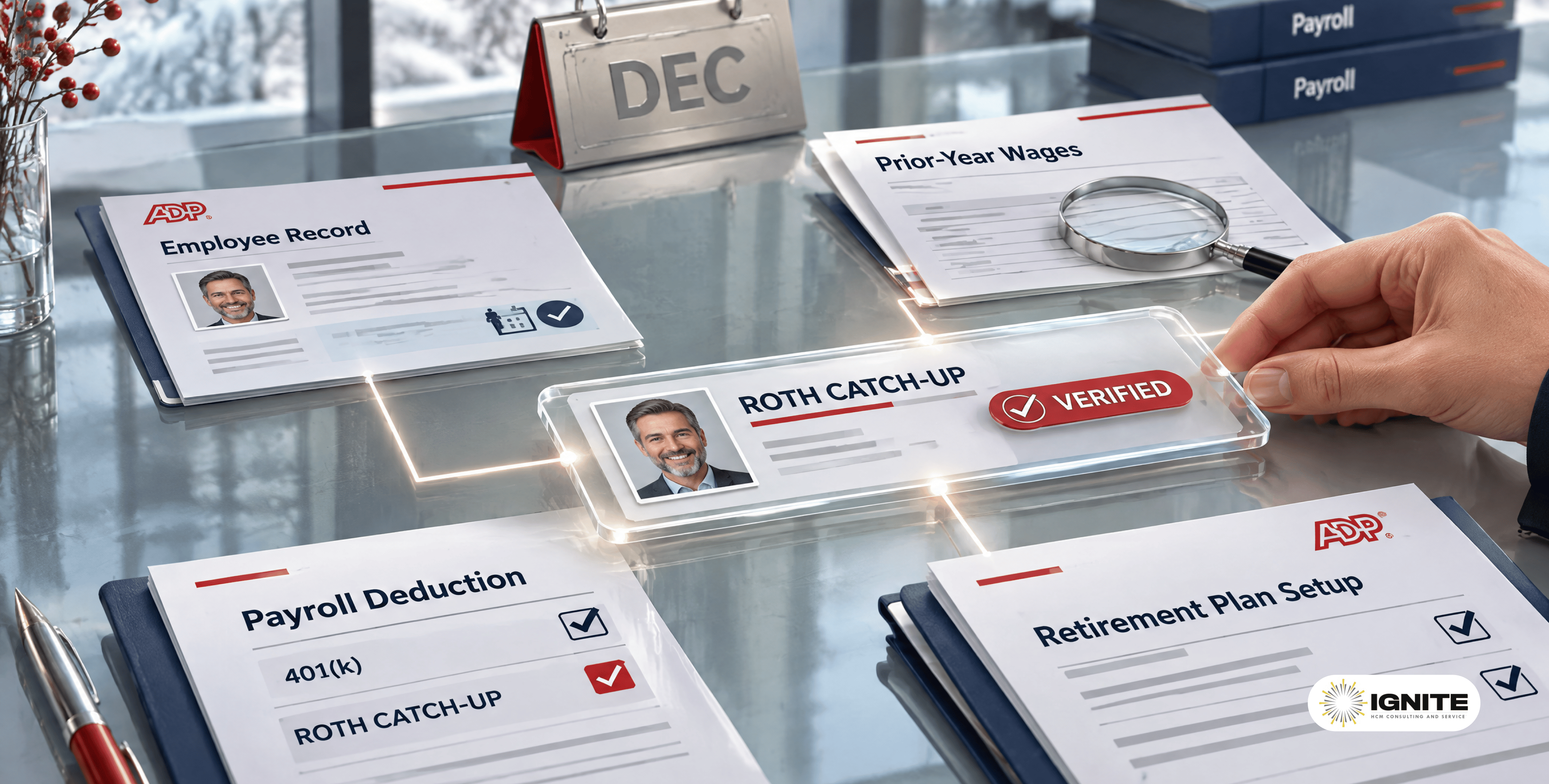
At a high level, the review identifies who crossed the wage threshold, verifies the deduction and contribution codes behind their catch-up deferrals, checks the tax treatment flowing to W-2 boxes, and confirms the recordkeeper feed matches. We walk through the full sequence with clients, but the short version of what to look at first: confirm your plan actually permits Roth contributions at all, pull a list of catch-up-eligible employees against prior-year wages, and spot-check how their fourth-quarter deferrals were coded. The complete review steps are in the Ignite HCM Year-End Checklist (ignitehcm.com/yearend-guide).
The expensive version of this story repeats itself every year. A company amends its plan on time and assumes the payroll setup followed. It didn't. A handful of executives' catch-up contributions run as pre-tax for most of a year, nearly a full year of deferrals coded wrong. The unwinding involves corrective recharacterizations, W-2 corrections, unplanned tax bills for some of the most visible people in the company, and an uncomfortable series of conversations between HR, the CFO, and the plan's counsel. Professional fees and corrections land well into five figures, not counting the internal hours. The plan document had been right the whole time.
Not quite. The amendment was necessary but not sufficient. Until someone verifies the payroll codes and the recordkeeper feed match the amendment, you have compliance on paper and an open question in practice.
Before your final 2026 payroll, ideally. That's your last chance to correct this year's contributions cleanly, and it's also when you need clean wage data to determine who's affected in 2027.
Corrective distributions or recharacterizations, corrected W-2s, surprise tax consequences for the employee, and potential plan qualification issues if errors pile up uncorrected. It's fixable, but the fix gets more expensive every month it waits.
Ignite HCM works with ADP exclusively, and our consultants are former ADP service professionals who have set up and audited these exact codes from the inside. No tickets, no hold queues — a dedicated consultant reviews your setup, your affected-employee list, and your recordkeeper coordination with you. We've got you.
Year-end is won in November, not January. Grab the free Ignite HCM Year-End Checklist or REQUEST A CONSULTATION and we'll run it with you.
ADP and the ADP logo are registered trademarks of ADP, Inc. This article is general guidance only, not tax, legal, or benefits-compliance advice. Confirm thresholds, timing, and plan specifics with your licensed advisor.