Every January, the same story plays out in payroll departments across the country. W-2s go out, and within a week the calls start. "My name is spelled wrong." "This isn't my address." "My Social Security number is off by one digit." Each of those calls means a W-2c correction, a paper trail, and a payroll team spending February cleaning up something that could have been caught in October.
Here's the part that stings: almost none of these problems start in January. They start months earlier, when a new hire's name gets keyed in from a hard-to-read form, when someone moves and never tells HR, or when a data conversion carried over a typo nobody noticed. The W-2 just shines a bright light on data that was wrong all along.
The good news is that October is the perfect time to fix this. You have the time, you have the tools inside ADP Workforce Now, and your employees are still around to answer questions. A few focused hours of auditing now can save you weeks of corrections later. Let's walk through how to do it.
A W-2 is only as accurate as the employee record behind it. The name, Social Security number, and address on the form come straight from the master data in your payroll system. If any of those fields are wrong on December 31, they're wrong on the W-2, and once forms are filed, the only fix is a formal correction.
Corrections are not a small thing. A W-2c takes time to prepare, has to be furnished to the employee, and may need to be filed with the Social Security Administration. If the error touches wages or taxes, you may be amending returns too. Multiply that by a dozen employees and your first quarter is spoken for.
There's also the trust cost. When an employee gets a W-2 with their name misspelled or an old address, their confidence in payroll takes a hit. And when their tax filing gets delayed because of a mismatch, that frustration lands squarely on your desk.
The cheapest correction is the one you never have to make. That's the whole case for a fall data audit: find the errors while they're still just database fields, not government filings.
The Social Security Administration matches the name and SSN on each W-2 against its own records. When they don't line up, the wages may not post correctly to the employee's earnings history, and employers can receive notices asking them to resolve the discrepancy. That's a headache you want no part of.
Mismatches usually come from mundane causes. A last name changed after marriage or divorce, but the employee never updated their Social Security card, or never told HR. A hyphenated or two-part surname got entered differently than SSA has it. A transposed digit slipped in during onboarding. Nicknames are a classic one: the employee goes by "Kate" and that's what got entered, but SSA has "Katherine."
The rule of thumb we give clients is simple: the name in payroll should match the name on the Social Security card, character for character. Not the preferred name, not the email display name, the card. ADP Workforce Now can hold a preferred name separately, so employees can still be "Kate" everywhere that matters day to day while the legal name field stays aligned with SSA.
If you find a mismatch, resolve it now, while the employee is a quick message away. In February, that same question takes three times as long to answer.
An outdated address does two kinds of damage. The obvious one is delivery: paper W-2s mailed to an old apartment get returned, forwarded late, or lost entirely, and now you're reissuing forms in the middle of tax season while the employee worries about who's holding an envelope with their SSN on it.
The less obvious damage is taxation. In many states, the employee's home address drives state and local tax withholding and reporting. An employee who moved from one state to another mid-year, without updating their record, may have had an entire half-year of withholding sent to the wrong state. Local taxes make it messier: some jurisdictions tax based on where you live, and a stale address can mean the wrong locality got the money. Untangling that after year-end involves amended filings and an employee who owes tax somewhere they didn't expect.
Remote and hybrid work has made this a much bigger deal. People move more freely now, and plenty of them forget that payroll needs to know. Catch it in October and you can correct the remaining pay periods and get ahead of the reconciliation. Catch it in January and you're doing archaeology.
You don't have to verify hundreds of records by yourself, and you shouldn't try. The person best positioned to confirm an employee's name, SSN, and address is the employee. ADP Workforce Now's self-service tools let them view their own information and, depending on your configuration, update items like home address directly.
The play here is a short, friendly campaign. Send a message in late October: "W-2s are coming. Take two minutes, log in, and confirm your name, address, and Social Security number are correct. Here's how." Give them a deadline in mid-November, and send one reminder.
Two practical tips. First, be clear about what employees can change themselves versus what needs to go through HR. Address changes are usually self-service; legal name and SSN changes typically need documentation, so route those to a person. Second, encourage electronic W-2 consent while you have their attention. Every employee who opts in for an electronic form is one less envelope that can go astray.
Participation won't be 100 percent, and that's fine. Every record an employee verifies is one you don't have to chase, and the audit reports will catch the rest.
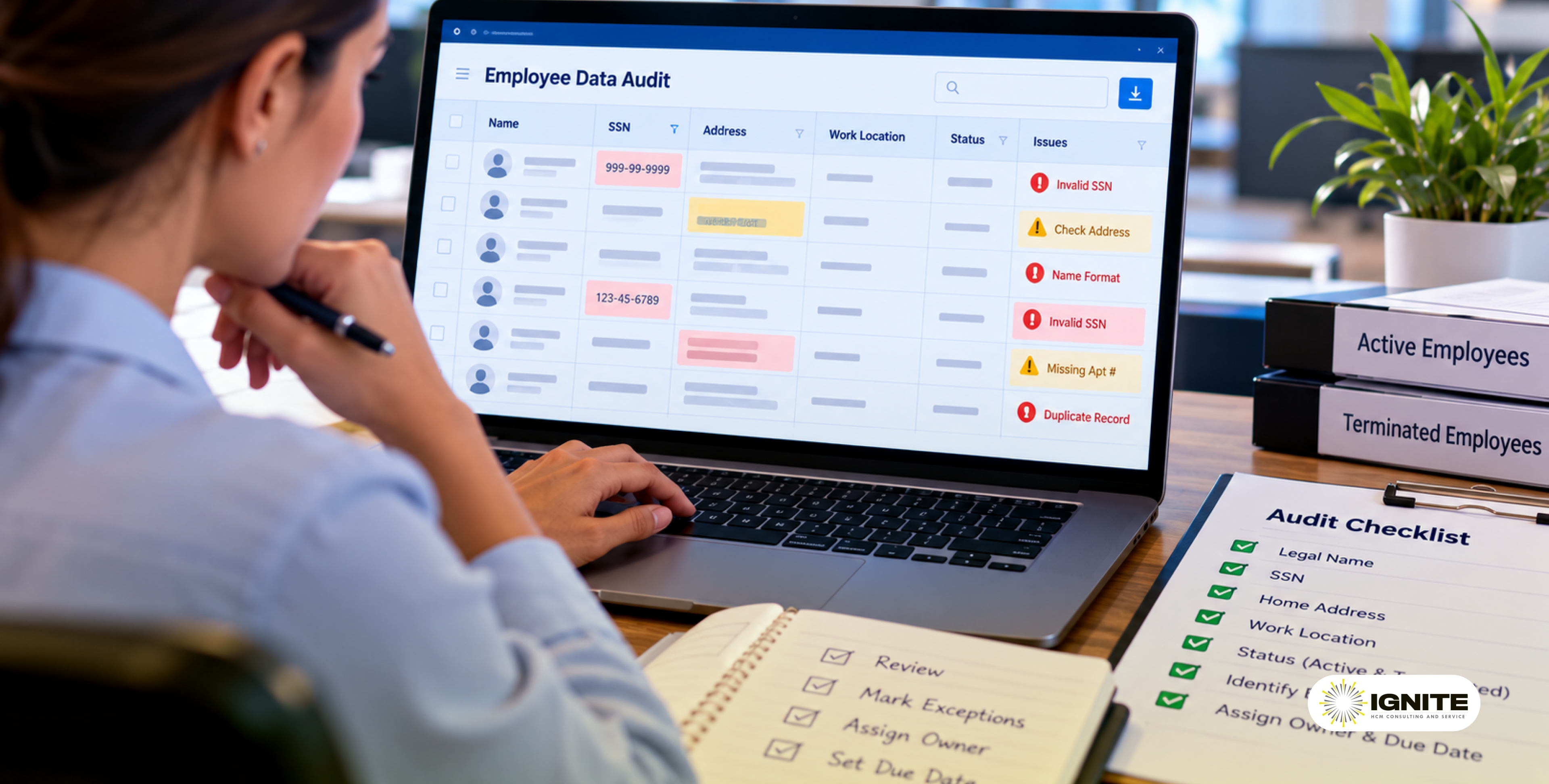
Self-service covers the willing. Reporting covers everyone. ADP Workforce Now's reporting tools let you pull employee demographic data across your whole population so you can review it systematically instead of one profile at a time.
Pull a roster with legal name, SSN, home address, work location, and status, and go hunting for the usual suspects. Missing or placeholder SSNs, the 999-99-9999 entries someone keyed to get past a required field during a rushed onboarding. Names in all caps, names with stray punctuation, first and last names that look swapped. Addresses missing an apartment number, a ZIP code that doesn't match the city, a state that doesn't match any work location you have. Duplicate records for the same person, especially after rehires.
Don't limit the audit to active employees. Anyone paid at any point during the year gets a W-2, including the seasonal worker who left in June and the employee terminated in August. Terminated employees are the highest-risk group for stale addresses because nobody is prompting them to update anything. For that group especially, a quick outreach asking them to confirm a mailing address is worth the effort.
Export the results, mark up the exceptions, and assign each one an owner and a date. An audit that ends as a spreadsheet nobody acts on is just a list of future W-2cs.
Timing matters. Corrections made before your last payroll run of the year flow naturally into year-end processing. Corrections made after the year closes are a different animal, so the goal is simple: every fix in the system before that final December run.
Work backward from your payroll calendar. If your last check date is in late December, your fixes should be finished by early December, which means outstanding questions to employees need to go out by mid-November, which means the audit itself should happen in late October or early November.
Prioritize by impact. SSN and legal name issues come first because they affect SSA matching. State and local address issues come next because they touch tax jurisdictions. Simple mailing address updates matter, but they're the easiest to fix and the least damaging if one slips through. And when you correct a mid-year state move, don't just update the address field. Confirm the tax jurisdictions on the employee's record updated with it, and flag the wages already reported to the old state so year-end reconciliation isn't a surprise.
A client with about 400 employees across three states came to us in late October after a rough prior year: 35 W-2 corrections, most of them addresses and two SSN mismatches that took months to resolve. They wanted a different January.
We started with an audit report across everyone paid that year, active and terminated. The first pass flagged roughly 60 records: about 40 questionable addresses, a dozen name formatting problems, six missing apartment numbers, and three SSNs that failed a basic format check. Then we ran a two-week self-service campaign asking all employees to verify their own information, which surfaced another 15 issues the reports couldn't see, including two cross-state summer moves nobody knew about.
Every exception got an owner and a due date. HR handled the documented name changes, employees fixed their own addresses, and payroll corrected the state tax setup for the two movers with several pay periods left to true things up. Total effort was about 30 hours over three weeks. That January, the client issued four W-2 corrections instead of 35, and every one of the four involved information no audit could have caught in advance. The payroll manager said it was the first February in years she wasn't apologizing to anyone.
Late October or early November is the sweet spot. Employees are around to answer questions, and you have enough pay cycles left to correct state withholding issues gradually instead of in one scramble. Starting in January means you're not auditing anymore, you're correcting.
The payroll record should match the card. If the employee's legal name has changed, the right sequence is for them to update it with the Social Security Administration first, then bring you the documentation so payroll can follow. Don't change the system based on a verbal request alone, and don't guess. When in doubt on a specific case, loop in counsel, since verification rules have their own requirements.
Yes, and they're usually the biggest source of returned mail. Anyone you paid during the year gets a W-2, and former employees have no reason to log in and update an address. A short email or letter asking them to confirm where their W-2 should go, sent in November, prevents most of it.
The best version of this isn't an annual scramble, it's a habit. Verify the name against the Social Security card at hire, every time, before the first payroll. Build address confirmation into your workflows so a move triggers a review of tax jurisdictions, not just a new mailing label. Run a light version of the audit report quarterly, fifteen minutes to scan for new exceptions, so October's list is short. And keep pushing electronic W-2 consent, because every opt-in removes a mailing risk permanently.
Teams that work this way head into January calm. The W-2s go out, the phone stays quiet, and February belongs to this year's work instead of last year's cleanup.
If your data needs more attention than your team has hours, that's where we come in. Ignite HCM is staffed by former ADP service professionals, and we work with ADP exclusively, so we know exactly where the audit reports live, what the exceptions mean, and how to fix them without breaking something else. No tickets, no hold queues. You get a dedicated consultant who treats your year-end like their own.
Want a quiet January instead of a stack of W-2cs? REQUEST A CONSULTATION.
ADP and the ADP logo are registered trademarks of ADP, Inc. This article is general guidance, not tax or legal advice. Confirm specifics with your licensed advisor.