
Every January, somewhere in America, a controller closes the December books, a payroll manager finalizes the W-2s, and the two sets of numbers disagree about what December cost. Finance booked the last week of December as 2026 wage expense, because that’s when the work happened. Payroll reported those same wages as 2027 income, because that’s when the checks paid. Both are right. And if nobody planned for the gap, both will spend February proving it — to each other, to the auditors, and to fifty employees who want to know why their December hours aren’t on their W-2.
This is the accrual-versus-cash mismatch, and it is the most predictable reconciliation problem in year-end payroll. It isn’t an error. It’s two correct systems measuring the same money with different calendars. The general ledger runs on accrual: expense belongs to the period the work was performed. Payroll tax reporting runs on cash: wages belong to the year the employee is paid. A paycheck dated January 2, 2027 is 2027 income on the W-2, even if every hour on it was worked in December 2026 and every dollar of it sits in your 2026 expense.
Here’s why this matters right now, in November. The decisions that determine which year your final paychecks land in — and therefore how big the gap between your books and your W-2s will be — get made before the last December payroll runs, not after. Once that run processes, the tax year of those wages is locked, and so are your W-2 totals, your employer tax liability, and the reconciling item your finance team will carry into close.
The payroll side of this rests on a concept called constructive receipt: income is taxed when it’s made available to the employee without restriction, which for payroll means the pay date on the check or deposit. Not the period-end date, not the day the timecard was approved. The check date governs. We’ve covered the bonus-timing side of this rule separately; today’s point is narrower. Once you accept that the check date controls the tax year, the question stops being “which year are these wages?” and becomes “do our books, our filings, and our people all understand the answer?”
Employees build a mental model of their annual pay from their work, not their pay dates. Someone who worked overtime through the holidays, started a new salary on December 1, or earned a December commission expects to see all of it reflected in the year it “happened.” When the W-2 comes up short of that mental math, they assume an error, and they call payroll.
This matters more than hurt feelings. Confused employees file questions, and enough questions can stall your W-2 distribution season — remember that 2026 W-2s and 1099-NECs are due February 1, 2027, since January 31 falls on a Sunday. A short, plain-English note sent with the final December pay stubs — your W-2 reflects checks dated in 2026, so pay for late-December work paid in January will appear on next year’s W-2 — prevents most of it. Writing that note is a November task.
Now the finance side. At year-end, three documents describe your labor cost: the general ledger, the quarterly employment tax filings, and the W-2 totals. The GL includes the December accrual for wages paid in January. The W-2s don’t. The difference between them should be a known, documented number — the accrued payroll at December 31 — and when it is, your auditors nod and move on.
When it isn’t documented, the same number becomes a mystery variance. Someone compares total W-2 wages to booked compensation expense, finds a gap, and launches an investigation into a discrepancy that was never wrong in the first place. The cure is a one-page schedule, built before close: which pay periods straddle the year, what the accrual entry covers, and exactly why the W-2 totals differ from booked wage expense. Teams that build that schedule in November close the year smoothly. Teams that don’t spend February explaining arithmetic to their auditors.
A handful of choices have to be settled jointly — not by payroll alone — before your final 2026 payroll processes, because they control both the tax year of the wages and the size of the accrual. Among them:
That’s a sample, not the list. The full set of cross-year decisions, including the ones about third-party sick pay and deferred compensation timing that catch people off guard, is in the Ignite HCM Year-End Checklist (ignitehcm.com/yearend-guide).
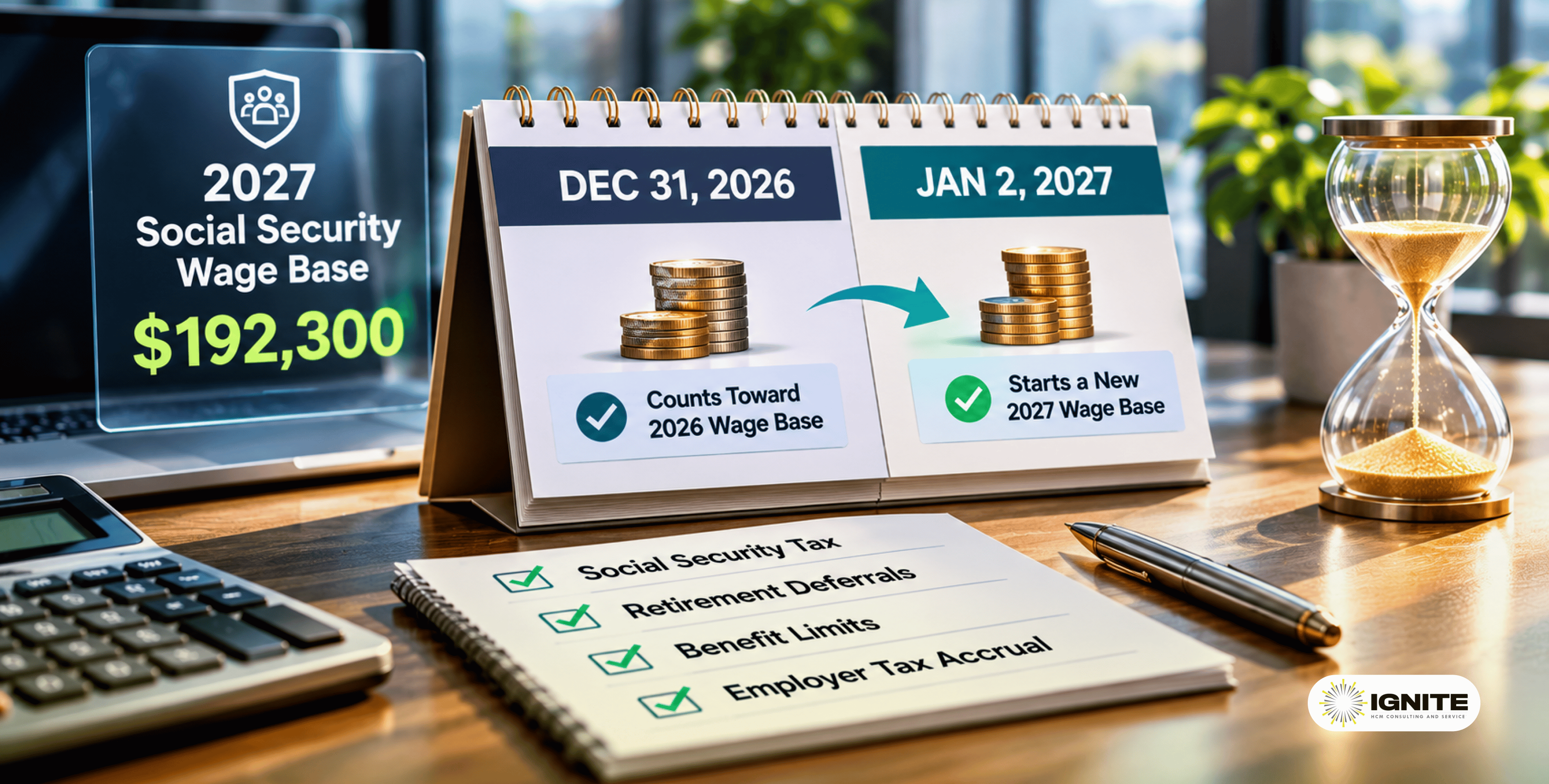
Pay-date timing isn’t just a reporting technicality. It moves actual tax dollars. The 2027 Social Security wage base is $192,300. An executive payment dated December 31, 2026 counts against the 2026 wage base; the same payment dated January 2, 2027 starts fresh against the 2027 base. Depending on where the employee sits relative to the cap, the timing changes Social Security tax for both the employee and the company — which also changes the employer tax accrual finance is booking. The same logic touches retirement deferrals, which reset with the new year, and benefit limits. These are legitimate planning decisions with real consequences, and they expire the moment your last December run processes. Talk them through with your advisor while the calendar still gives you choices.
Every year-end has its own calendar personality, and this one has two quirks worth circling. First, the W-2 deadline itself moved: because January 31, 2027 falls on a Sunday, 2026 W-2s and 1099-NECs are due February 1, 2027. That extra day is not a planning strategy, but it’s worth knowing when you map your January.
Second, any pay date that would normally fall on or near January 1 forces a choice. Holiday processing schedules, bank closures, and direct deposit timing can quietly shift a check from one year into the other, and with it, every consequence we’ve described — the tax year, the W-2 totals, and the accrual. If your normal calendar would produce a check dated in that window, decide on purpose which side of the line it lands on, and tell finance which side you chose. Confirm your processing deadlines with ADP early, because holiday cutoffs come days before the check dates they support, and a missed cutoff makes the decision for you.
Here’s a version of this we hear every January. The books close. Sometime in February, an auditor — or a sharp-eyed CFO reviewing the compensation accounts — compares booked wage expense against the payroll filings and finds a gap nobody can explain on the spot. Payroll insists the W-2s are right, because they are. Finance insists the expense is right, because it is. But the accrual schedule was never written down, the one person who understood the straddling pay period has twenty other February fires, and what should have been a footnote becomes weeks of cleanup: re-deriving the accrual, tying out each cross-year period, and walking the auditors through a “discrepancy” that was never an error. Meanwhile, employees who were told their December hours would be on the W-2 are calling about documents that are, maddeningly, correct. One November conversation between payroll and finance — and one page of documentation — prevents the whole thing.
Not by itself. They shouldn’t match if you accrue December wages. The problem is an undocumented difference. If you can produce the schedule that explains the gap, you’re done. If you can’t, build the reconciliation now, while the people who know the answers aren’t buried.
Before your last payroll with a 2026 check date is processed. After that run, the year’s wage totals are effectively set, and anything you wanted in 2026 that didn’t make it becomes a 2027 event. Work backward from your final check date and build in review time.
The truth, early: W-2s report checks dated in 2026, so late-December work paid in January appears on the 2027 W-2. One paragraph sent with the final pay stubs saves your January inbox.
Ignite HCM supports ADP platforms like ADP Workforce Now exclusively, and our consultants came out of ADP’s own service organization. We’ve sat on both sides of the payroll-and-finance table: cross-year pay calendars, accrual tie-outs, W-2-to-GL reconciliations, and the employee communications that keep January quiet. No ticket queue and no waiting on hold. You get a dedicated consultant who knows your calendar and answers the phone. Hair on fire? Call us.
Year-end is won in November, not January. Grab the free Ignite HCM Year-End Checklist (ignitehcm.com/yearend-guide) — or REQUEST A CONSULTATION (ignitehcm.com/solutions/payroll-processing) and we’ll run it with you.
ADP and the ADP logo are registered trademarks of ADP, Inc. This article is general guidance only, not tax or legal advice. Confirm how constructive receipt and wage timing apply to your situation with your licensed tax advisor.