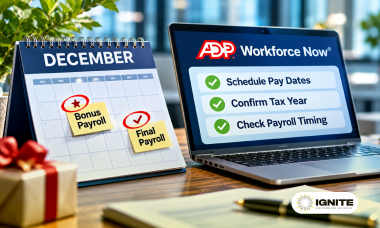
There’s a particular phone call payroll consultants get every year in the first week of January. It starts with “our December bonuses didn’t pay out until January 2” and it ends with someone realizing that a year’s worth of planning — the CFO’s compensation budget, the employees’ tax expectations, sometimes the retirement plan math — just slid into the wrong tax year because of a calendar.
December is the least forgiving month on the payroll calendar, and it’s not close. Bank holidays compress the processing windows. Half the office is on vacation, including the people who approve things. Every payroll you run is colliding with year-end close activities. And looming over all of it is a boundary that doesn’t negotiate: the tax year ends at midnight on December 31, and which side of that line a payment lands on is determined by rules, not intentions.
If you’re running bonus payrolls or juggling final pay dates in ADP Workforce, Now this December, the decisions that matter are mostly made in November. Here’s why the scheduling is so unforgiving, how the tax-year boundary actually works, and what has to be decided by when. The full scheduling sequence with specific decision deadlines is in the free Ignite HCM Year-End Checklist (https://www.ignitehcm.com/yearend-guide).
Payroll tax law runs on a concept called constructive receipt, and at a general level it works like this: wages are taxed in the year the employee receives them or could have received them, not the year they were earned, promised, or approved. A bonus for stellar 2026 performance, approved by the board in November 2026, that pays with a check dated January 2, 2027, is 2027 income. It goes on the 2027 W-2, counts against 2027 limits, and shows up in the employee’s 2027 taxes.
That means the single most important field in your entire December bonus plan is the check date. Not the approval date, not the pay period, not the date someone hit submit. If leadership expects bonuses in the 2026 tax year — and employees planning around their tax situations usually do — then a 2026 check date is a hard requirement, and everything else in the plan works backward from it.
The same logic governs your regular payrolls at the boundary. A pay period that spans late December into January is taxed entirely by its check date. Teams are sometimes surprised that the first payroll of January is “all 2027” even though most of the hours were worked in 2026. That’s normal and correct. What’s not correct is discovering your intended last-2026 payroll carries a 2027 check date because nobody looked.
In a normal month, payroll runs on comfortable rails: submit by the deadline, funds move, employees get paid. December attacks every link in that chain at once.
Bank holidays remove processing days exactly when you need them most, and when a scheduled pay date collides with a holiday or weekend, the date moves — which matters enormously if it moves across the year boundary. Processing lead times still apply, meaning the submission deadline for a late-December check date arrives days earlier than the date itself, and an off-cycle bonus run needs its own slot in that compressed calendar. Approval chains slow down as decision-makers go on vacation. And ADP’s year-end processing calendar has its own cutoffs layered on top of your own.
None of this is exotic. It’s the ordinary machinery of payroll with the slack removed. The teams that get burned aren’t careless; they’re teams that scheduled December like it was May.
A December bonus payroll isn’t one decision, it’s a stack of them, and each has a deadline that’s earlier than it feels. The ones that can’t wait:
Those four get the conversation started; the complete decision list with recommended deadlines is in the Ignite HCM Year-End Checklist (ignitehcm.com/yearend-guide). The pattern to notice is that every one of these is a November conversation. By mid-December, you’re no longer making decisions. You’re living with them.
Bonus runs carry second-order effects that deserve deliberate choices rather than defaults. Should 401(k) deferrals come out of the bonus? For some employees that’s exactly what they want, especially anyone chasing the annual contribution limit before December 31. For others it’s an unwelcome surprise. Either way, it’s a plan-document and employee-communication question, not just a system setting. On limits themselves, a planning note: the IRS has not yet announced official 2027 retirement plan limits — projections based on CPI put the 401(k) deferral at $25,500 and the age-50 catch-up at $8,500, pending the official notice expected mid-November — so 2027 elections should be revisited once the real numbers land.
Similar questions apply to other deductions: benefits premiums, garnishments, charitable elections. Each one either applies to the bonus run or doesn’t, and “whatever the system did” is not an answer you want to give an executive in January. Decide, document, and communicate before the run.
The flip side of December scheduling is the handoff. Your first 2027 payroll arrives carrying new state and local minimum wages that take effect January 1 in many states, fresh annual limits that reset at zero, and 2027 HSA limits that are already official at $4,500 self-only and $9,000 family. Social Security withholding restarts for the high earners whose withholding stopped mid-2026. If your December scheduling slid any payments across the boundary, those payments now live in this new world, under the new figures. Confirming your first 2027 check date and reviewing what applies to it belongs on the same planning sheet as the December runs, because it’s the same calendar.

Here’s a story we hear some version of every January. A company plans a December bonus run — dozens of employees, serious money, all of it intended for the 2026 tax year. The amounts get approved on December 22. Between the approval date, the processing lead time, and the holiday schedule, the earliest available check date is January 2.
The bonuses pay fine — in the wrong year. Several employees had made charitable gifts and retirement decisions assuming the income would land in 2026. A couple had planned deferral strategies around it. The company’s compensation expense and its payroll tax figures shift across fiscal reporting lines. There’s no form to file and no penalty to pay, which is what makes it painful in a different way: nothing is technically broken, so nothing can be fixed. The cost is a wave of employee frustration, a board question about how it happened, and a finance team reconciling a timing difference that distorts two fiscal years at once. The prevention was a calendar conversation in mid-November.
Check one thing: whether your usual bonus timing leaves slack for this year’s specific holiday calendar. The pattern that worked when the dates fell kindly can fail in a year they don’t. Five minutes against the actual 2026 calendar settles it.
Lock decisions in November; lock amounts by early December. The hard processing deadlines come from ADP’s calendar and your bank’s, but the practical deadline is earlier, because approvals in late December move at vacation speed.
It’s taxed, reported, and counted against limits in the year it actually paid. There’s rarely a way to move it back. The damage is to employee tax planning, your budget-year alignment, and trust — none of which show up on a penalty notice, all of which are real.
December scheduling is a solved problem when someone in the room has done it a few hundred times. Our consultants spent years inside ADP’s service organization before joining us, and ADP is still the only platform we touch. We build December payroll calendars with clients every year: bonus run setup in ADP Workforce Now, check-date strategy on the right side of the year boundary, deduction decisions, and the processing deadlines mapped against the real holiday calendar. One dedicated consultant instead of a queue. Your people need to get paid. We make that happen, in the right year.
Year-end is won in November, not January. Grab the free Ignite HCM Year-End Checklist (ignitehcm.com/yearend-guide) — or REQUEST A CONSULTATION (ignitehcm.com/solutions/payroll-processing) and we’ll run it with you.
ADP and the ADP logo are registered trademarks of ADP, Inc. This article is general guidance, not tax or legal advice — confirm specifics with your licensed advisor or ADP representative.