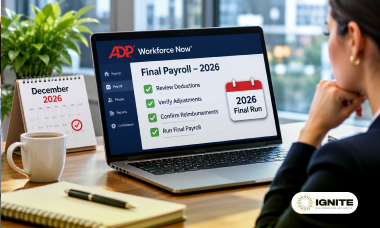
Every payroll you’ve run this year had a safety net: the next payroll. Missed a deduction? Catch it up next cycle. Overpaid someone? Adjust it on the following check. Forgot a reimbursement? Two weeks and it’s handled. That rhythm is so reliable that most payroll teams stop thinking about it.
Your last payroll of 2026 has no next cycle. Whatever processes on that final check date is what the 2026 tax year says happened. Whatever didn’t make it in belongs to 2027, whether you meant it to or not. The next payroll after this one lands in a different tax year, feeds a different W-2, and can’t retroactively fix anything about 2026 without formal correction work.
That’s why experienced payroll people treat the final run of the year as its own event, with its own preparation, instead of just another cycle in December. If you’re on ADP Workforce Now, here’s what makes the final run different, what has to be verified before you process it, and what can and can’t be rescued afterward. The complete final-run sequence with dates is in the free Ignite HCM Year-End Checklist (https://www.ignitehcm.com/yearend-guide).
Once your last 2026 payroll processes, ADP’s year-end machinery starts turning. Year-to-date totals become the raw material for W-2s, quarterly filings get finalized, and the window for clean adjustments narrows to a crack. There are limited late-adjustment options after the final run, but they come with their own cutoffs and constraints, and anything discovered after forms are produced becomes a W-2c and possibly an amended return.
The practical consequence: every pending item sitting in your system right now — every half-finished manual check, every void you’ve been meaning to enter, every bonus that’s “probably going on the last check” — needs a decision and a deadline. Items without a plan default to becoming January problems, and January problems cost many times what December decisions do.
Start with everything that’s in-flight. Payroll systems accumulate loose ends over a year, and the final run is where they all come due. The verification pass should cover items like:
Those four are the headline items; the full pending-item sweep is in the Ignite HCM Year-End Checklist (ignitehcm.com/yearend-guide). The common thread: each of these changes someone’s year-to-date totals, and year-to-date totals are about to become W-2s. A manual check that never gets recorded is income the W-2 won’t show. A void that never processes is income the W-2 will show that the employee never kept.
December bonuses deserve their own planning, and most of it is about timing and setup rather than amounts. A bonus intended for the 2026 tax year must have a 2026 check date, which means it has to be scheduled against ADP processing lead times and a December calendar full of bank holidays. A bonus that slips to a January check date is 2027 income, full stop, no matter when the decision was made.
Beyond timing, bonus runs carry setup questions that need answers before processing, not after: how the payment should be taxed, whether retirement deferrals and other deductions should apply to it, and whether it’s running inside a regular cycle or as its own off-cycle payroll. Each of those choices changes the employee’s net pay and the year-end totals, and each is painful to unwind once the run processes. Name the decisions now, make them deliberately, and leave slack in the schedule for a dry run.
The final run is the last chance for every deduction that’s supposed to hit an annual target. Goal-based deductions that are short of goal, retirement contributions an employee wanted to max out, HSA contributions against the annual limit, benefit arrears that accumulated during leaves of absence — all of it either resolves on the final check or carries an error into year-end reporting.
This is also the moment to look at the opposite problem: deductions that overshot. A deferral that ran past its limit or a goal that didn’t stop where it should have needs attention before year-end, because the correction options get worse with time. The work here is running the comparisons — year-to-date actuals against targets and limits, employee by employee — and queuing the catch-up or correction entries for the final run. It’s detail work, it takes longer than people budget for, and it can’t start too early.
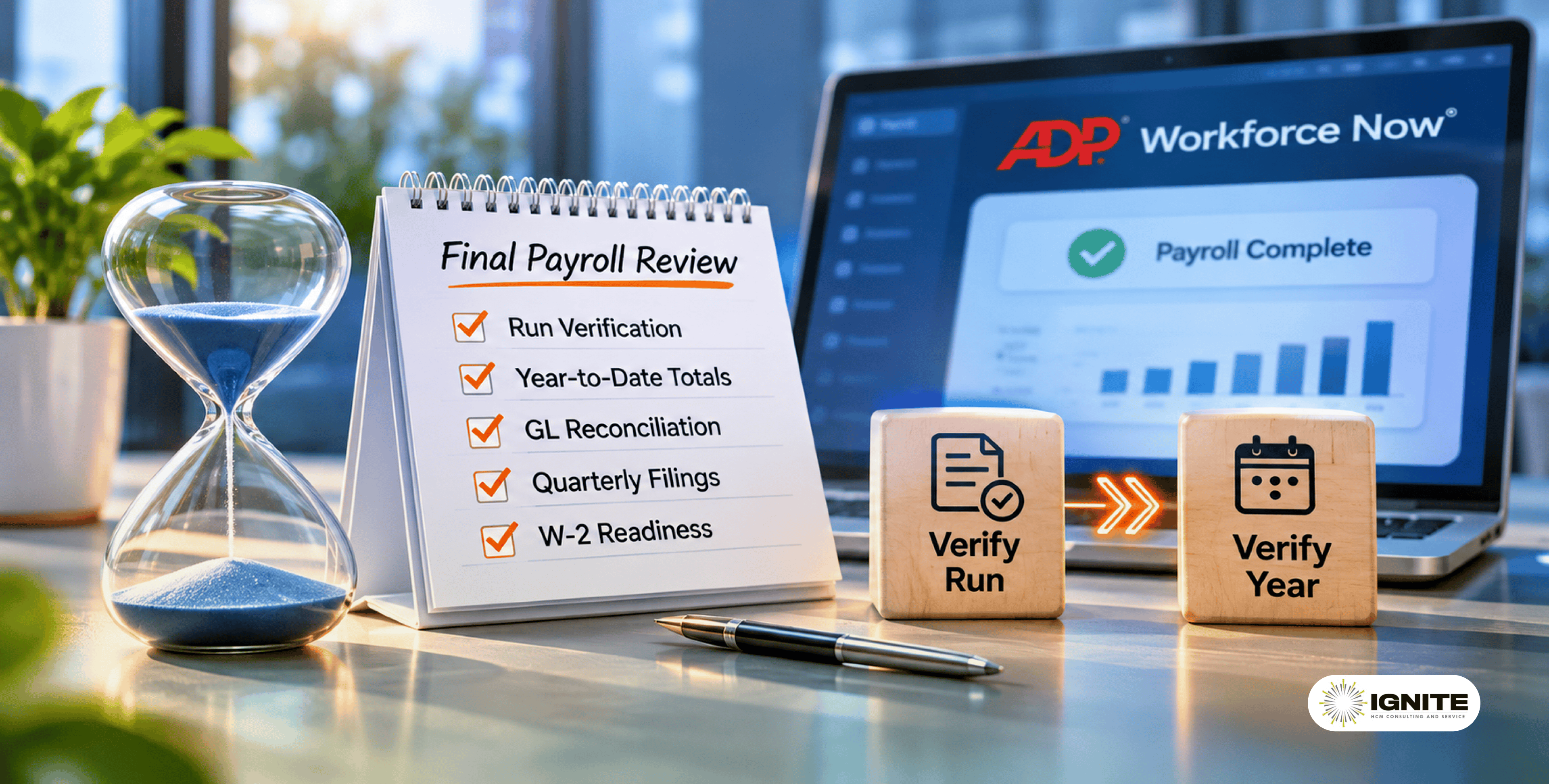
Before you release the final payroll, it deserves a sharper review than a normal cycle: the one-time items, the bonus entries, the catch-ups, the voids. After it processes, the job isn’t over — the year-to-date totals that now exist are your W-2 figures in waiting, and a final reconciliation pass against your general ledger and quarterly filings is what stands between you and a surprise in late January.
And know the boundary clearly: after the final run, some things can still be handled through late-window adjustments with ADP, and some things can’t. The difference between those two categories is exactly the kind of thing worth knowing before December 20 rather than discovering on January 5. We cover the distinction in the checklist, and it’s one of the most common questions we walk clients through live.
Here’s a story we hear some version of every January. A smaller company runs what it thinks is a routine final payroll. Sitting in a drawer, literally, are a handful of manual checks the owner wrote to employees during the year for spot bonuses — real pay that was never entered into ADP Workforce Now. Nobody remembers them until the CPA reconciles the bank account in late January.
By then W-2s are out. Several employees have W-2s understating their income, the employer’s filed totals come up short, and the fix involves corrected W-2s, amended filings, and late-deposit exposure on the taxes — weeks of cleanup and professional fees, plus the awkward conversation with employees whose tax documents changed after the fact. The prevention would have been one line on a final-run checklist: “Record all manual checks before the last payroll.”
About the regular cycles, no concern. But the final run fails on exactly the items regular cycles never touch: manual checks, voids, one-time bonuses, catch-ups. A year of clean payrolls says nothing about the drawer with the handwritten checks in it.
Earlier than feels natural. Between processing lead times and late-December bank holidays, final-run decisions made after mid-December are already running out of calendar. The planning should be done by early December; the final run itself just executes it.
Anything caught before processing is a quick fix. Caught after processing but before year-end close, you may have a narrow adjustment window. Caught after W-2s are produced, you’re into corrected forms, possibly amended returns, and employee-facing cleanup. Same error, three very different price tags, all depending on when you find it.
Final runs are where our background shows. Every consultant on our team came up through ADP’s service organization, and ADP is the only platform we work on — we’ve sat on the other side of hundreds of year-end closes. We review your pending items, bonus plans, deduction true-ups, and processing calendar inside ADP Workforce Now, then stay with you through the final run and the post-run verification. Instead of a ticket queue, you get one dedicated consultant on your schedule. Your people need to get paid. We make that happen, right through the last check of the year.
Year-end is won in November, not January. Grab the free Ignite HCM Year-End Checklist (ignitehcm.com/yearend-guide) — or REQUEST A CONSULTATION (ignitehcm.com/solutions/payroll-processing) and we’ll run it with you.
ADP and the ADP logo are registered trademarks of ADP, Inc. This article is general guidance, not tax or legal advice — confirm specifics with your licensed advisor or ADP representative.