Right now, somewhere in your ADP Workforce Now system, there is probably a number that doesn't match another number. Maybe it's a manual check that never made it into year-to-date totals. Maybe it's a pre-tax deduction coded as post-tax back in March. Whatever it is, it's sitting there quietly, and it will stay quiet until the worst possible moment: the week your W-2s print.
Here's the part that makes year-end so unforgiving. The 2026 W-2s and 1099-NECs are due to employees and contractors by February 1, 2027 (January 31 falls on a Sunday, so you get exactly one extra day). Every error you catch in November is a line item on a report. Every error you catch in February is an amended W-2, a confused employee standing at payroll's door during tax season, and possibly an amended employer filing behind it.
The good news: ADP Workforce Now already holds everything you need to find these problems early. You don't need new software or a heroic weekend. You need six categories of reports, run now, read carefully. Here's what each one reveals and why it matters.
This is the big one. A wage-and-tax tie-out compares what your payroll system says you paid and withheld against what was actually reported to agencies each quarter. When those figures agree, your W-2s will reconcile to your quarterly filings and your annual totals. When they don't, you've found the gap before the IRS or SSA finds it for you.
What this category of reporting catches: wages reported in one quarter but missing from year-to-date totals, withholding that drifted out of sync after a mid-year correction, and differences between taxable wages and gross wages that nobody can explain. Any one of those will surface on a W-2 as a number an employee, or an agency, will question. The tie-out is the difference between closing the year with confidence and closing it with crossed fingers.
Every deduction in your system has a tax treatment: pre-tax, post-tax, or somewhere in between depending on the benefit. A deduction audit reviews what was actually withheld all year against what each deduction code was supposed to do. It's where you discover that the new dental plan added in June was set up with the wrong taxability, or that an employee's 401(k) deferral stopped in August and nobody noticed.
Why it matters this time of year: deduction errors change taxable wages, and taxable wages are what land in Box 1 of the W-2. A miscoded deduction isn't just a benefits problem. It's a tax reporting problem that compounds with every payroll it runs through. Catch it in November and you're correcting a few pay periods. Catch it in February and you're amending forms.
W-2s get mailed and filed using the data in your system, not the data in your head. An employee data audit reviews the basics that make or break delivery and filing: names as they appear on Social Security cards, Social Security numbers, mailing addresses, and work-state assignments.
The stakes are bigger than returned mail. Name and SSN mismatches can trigger SSA notices. A wrong work state can mean withholding went to the wrong jurisdiction all year, which is a multi-state cleanup project nobody wants in Q1. And with remote work still reshuffling where people actually live, address and state data goes stale faster than most teams realize. November is when you ask employees to verify their information, because in January they're asking you why the W-2 went to their old apartment.
Several payroll amounts hit annual caps, and year-end is when the caps bite. The Social Security wage base matters here, and it's moving: the SSA has announced the 2027 wage base will be $192,300, so your highest earners will see changes in the new year. Retirement deferrals have annual limits too. The IRS hasn't announced the official 2027 retirement limits yet; current projections point to around $25,500 for elective deferrals with an $8,500 catch-up, but treat those as projections until the IRS speaks.
Limit-tracking reports show you who is approaching, hitting, or (worse) blowing past a limit. An employee who over-deferred to their 401(k) needs a corrective distribution, and those have their own deadlines and tax consequences. An employee whose Social Security withholding didn't stop at the wage base is owed money back. Both situations are far easier to handle inside the tax year than after it closes.
Every voided check, manual check, and off-cycle payment issued during 2026 either made it into your year-to-date totals or it didn't. This category of reporting lists them all so you can confirm each one landed where it should. Manual checks cut during a system outage, a termination payout handled outside the normal cycle, a voided direct deposit that was reissued: these are exactly the transactions that slip through.
Why this one hurts when it's skipped: a manual check that never posted means W-2 wages are understated. A void that was recorded but whose replacement wasn't means an employee's totals are wrong in the other direction. These are small transactions with outsized W-2 consequences, and the only way to find them is to look.
Finally, confirm that every tax liability your payrolls generated was actually deposited, in full, to the right agency, on time. ADP handles deposits for most clients, but "ADP handles it" is not the same as "I verified it." Rate changes, mid-year account number updates, new jurisdictions added when you hired in a new state: any of these can create a gap between what was owed and what was paid.
Deposit shortfalls come with penalties and interest that grow the longer they sit. A confirmation review in November gives you time to resolve discrepancies before quarterly and annual filings lock them in. It's twenty minutes of reading that can save a four-figure penalty letter.
One more note on what to do once these six categories are run: finding a discrepancy is only half the job. Each one needs a root cause, a correction, and a confirmation that the correction posted. The step-by-step follow-through for each report category is laid out in the Ignite HCM Year-End Checklist (ignitehcm.com/yearend-guide), so nothing you find in November is still open in December.
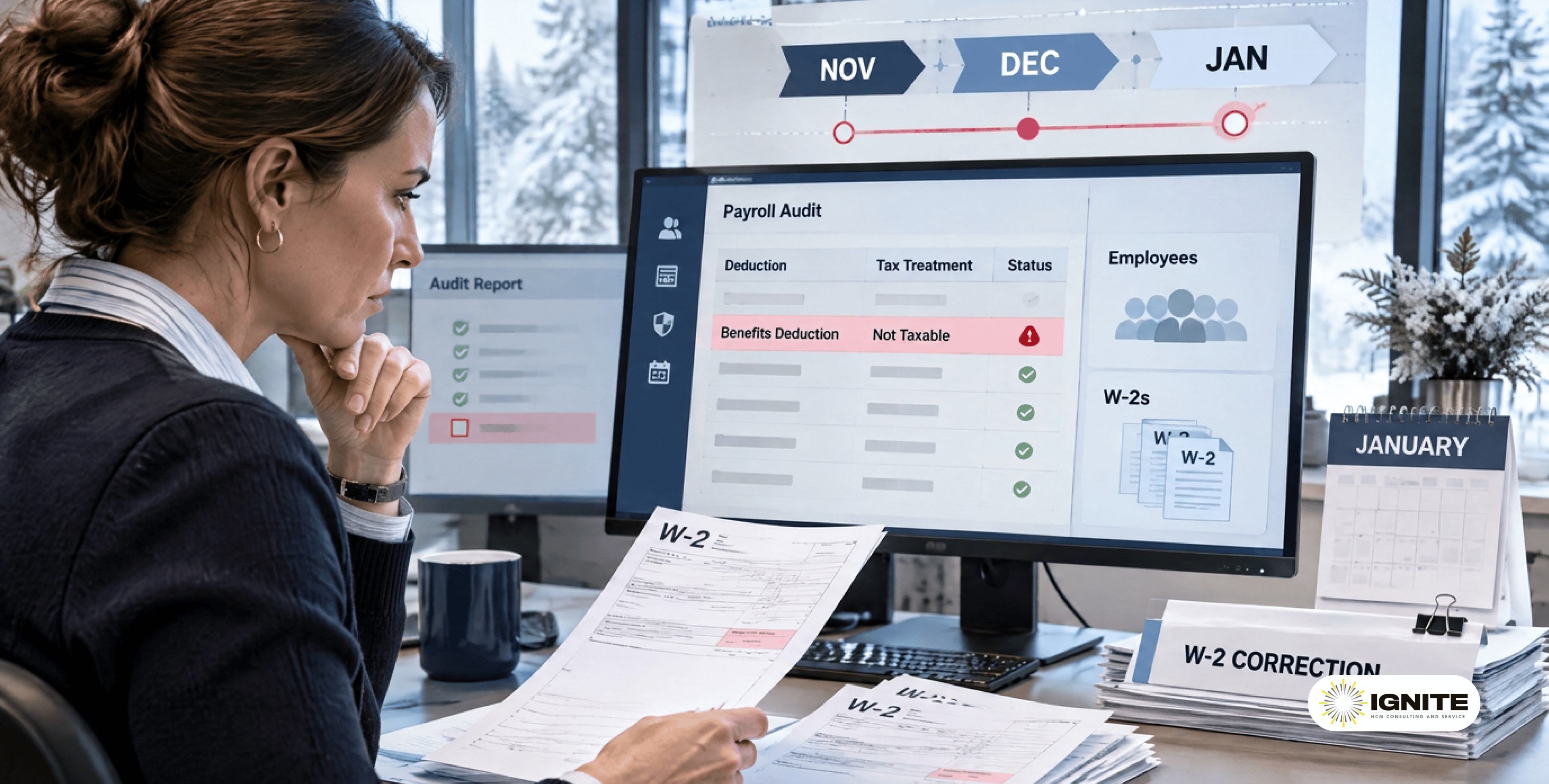
The call we get in January goes like this: W-2s have already gone out, and an employee's accountant is questioning Box 1. A benefits deduction added mid-year was set up with the wrong tax treatment and ran that way for a dozen or more pay periods across a few dozen employees. Nobody ran a deduction audit in the fall, so the W-2s carried the error out the door.
The damage: dozens of corrected W-2s, amended employer filings, a five-figure correction bill once penalties and outside help are counted, plus weeks of employee questions during the busiest season payroll has. Every bit of it would have shown up on one report in November.
If your payroll had zero mid-year changes, maybe not. But almost nobody has that year. New benefit plans, rate changes, manual checks, rehires, a new work state: each one is a chance for a quiet error. If any of those happened in 2026, these reports are worth your time.
Practically speaking, your last chance to fix 2026 cleanly is before your final payroll of the year processes. After that, corrections get harder, and after W-2s are issued, every fix becomes an amendment. The window is November through mid-December. It closes fast.
Corrected W-2s, amended quarterly filings, agency penalties and interest, corrective distributions for retirement over-deferrals, and the soft cost that's hardest to measure: your employees' trust in their own pay. None of it is catastrophic alone. Together, it can eat your whole first quarter.
Ignite HCM's consultants spent years inside ADP service before they ever worked an engagement for us, and we work with ADP exclusively. We know where these issues hide in ADP Workforce Now because we used to find them from the inside. And when you work with us, there's no ticket queue and no hold music: you get a dedicated consultant who runs the year-end review with you, start to finish. Hair on fire? Call us.
Year-end is won in November, not January. Grab the free Ignite HCM Year-End Checklist or REQUEST A CONSULTATION and we'll run it with you.
ADP and the ADP logo are registered trademarks of ADP, Inc. This article is general guidance only, not tax, legal, or accounting advice. Please confirm specifics with your licensed advisor.