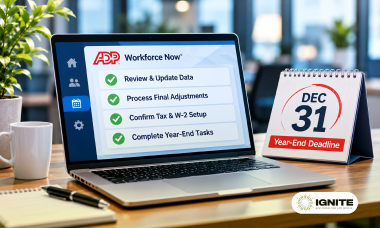
Every January, payroll teams across the country discover the same hard truth: year-end was already decided weeks ago. The W-2s that go out wrong, the amended returns, the angry calls from employees who filed their taxes early and now have to file again — almost all of it traces back to work that didn’t happen in November and December. Not work that was done badly. Work that was never done at all.
If you run payroll on ADP Workforce Now, you have a real advantage. The platform handles an enormous amount of the mechanics for you. But it can only calculate, file, and print what you’ve put into it, and the window to fix the inputs closes fast. Once your last payroll of 2026 processes and ADP begins producing W-2s, every error stops being a quick edit and becomes a correction project with its own paperwork, its own timeline, and its own cost.
So here’s the honest version of the year-end story: the next eight weeks are the whole game. Below is what actually has to happen between now and December 31, why each piece matters, and what it costs when a piece gets skipped. The execution details — the full task-by-task sequence with dates — live in the free Ignite HCM Year-End Checklist (ignitehcm.com/yearend-guide). This post is the map. The checklist is the route.
The single most common W-2 problem isn’t a tax calculation. It’s a name, Social Security number, or address that was wrong all year and nobody caught it. When the SSA receives a W-2 with a name and SSN that don’t match their records, you’ve got a mismatch on file, and your employee has a tax-season headache they will absolutely bring to your desk.
November is the time to sweep this, while there’s still room to collect corrections from employees. The work includes things like:
That’s a sample, not the full list. The complete data-verification sequence, with deadlines, is in the Ignite HCM Year-End Checklist (ignitehcm.com/yearend-guide).
Why it bites in January: 2026 W-2s are due to employees and filed by February 1, 2027 (January 31 falls on a Sunday). A bad SSN discovered on February 2 means a W-2c, a re-filing, and an employee who may already have filed a return against the wrong document.
Somewhere between your payroll registers, your general ledger, your quarterly 941s, and the amounts ADP will report on W-2s, every dollar has to tie out. Most of the time it does. But pre-tax deduction setup errors, mid-year earnings code changes, manual checks recorded outside the system, and voided payments that never got reversed all create quiet gaps between what was paid and what will be reported.
The reconciliation work means comparing year-to-date taxable wages across your sources and investigating every variance before the final payroll runs. Teams that do this in November fix problems with a payroll adjustment. Teams that skip it find the same problems in late January, after filings, when the only tool left is an amended return.
This is also where the statutory limits deserve a look: Social Security wage base behavior for your high earners, retirement deferral limits, and HSA contributions against the annual caps. One number worth knowing for planning: the SSA has set the 2027 Social Security wage base at $192,300, so your 2027 budget math changes too. For 2026 reporting, the question is simpler — did anyone’s withholding run past a limit, or stop short of one?
This is the category that ambushes otherwise careful teams. Taxable fringe benefits — personal use of a company car, group-term life insurance over $50,000, certain gift cards and awards, some relocation and education amounts, third-party sick pay — usually live outside the payroll system until someone deliberately brings them in. If they never make it onto a 2026 payroll, they never make it onto a 2026 W-2.
The work here is identifying every taxable item your company provided this year, valuing it correctly, and recording it through payroll before the final run. S-corporation owners have their own required items. Executives with perks have theirs. Finance usually knows about half of these; HR knows the other half; nobody holds the full list unless someone builds it.
Why it bites in January: fringe items discovered after W-2s are produced don’t just need a W-2c. They often change taxable wages for Social Security and Medicare, which means corrected employer tax, which means amended quarterly filings. One missed company-car calculation can ripple across four separate corrections.
Your last scheduled payroll of 2026 is the last clean chance to put anything into the 2026 tax year. Bonus runs, deduction catch-ups, manual check entries, void and reissue cleanups — all of it needs to be scheduled against ADP processing deadlines and bank holidays, which get unforgiving in late December.
A few of the items that belong on your final-payroll plan:
The full final-payroll sequence, including what can and can’t be fixed after processing, is in the Ignite HCM Year-End Checklist (ignitehcm.com/yearend-guide).

Year-end isn’t only W-2s. 1099-NECs for your contractors are due on the same February 1, 2027 timeline, and contractor records tend to be messier than employee records because nobody looks at them all year. Missing taxpayer identification numbers and incomplete addresses are the usual culprits, and November is when to chase them down.
Then there’s the handoff into 2027: new state and local minimum wages take effect January 1 in many states, retirement plan limits will change (the IRS hasn’t announced official 2027 figures yet — projections based on CPI put the 401(k) deferral at $25,500 with an $8,500 age-50 catch-up, pending the official notice expected mid-November), and the 2027 HSA limits are already official at $4,500 self-only and $9,000 family. Each of those touches payroll setup, and each deserves a verification pass, not blind trust that everything updated itself.
Here’s a story we hear some version of every January. A mid-size company, a capable payroll team of two, a December that got busy — and a fringe benefit sweep that never happened. In late January, the CPA asks where the personal-use auto amounts are for the managers with company cars, and where the group-term life imputed income is for everyone over the coverage threshold.
The answer is nowhere. W-2s are already out. The cleanup means corrected W-2s for dozens of employees, amended employer filings, and about three weeks of the payroll team’s time in the middle of their busiest season. The correction work and professional fees alone tend to run well into five figures, and that’s before counting the hours. The part that stings most: the original sweep would have taken two afternoons in November.
“Our ADP Workforce Now setup has run clean all year. Do we really need to do all this?”
A clean year is a great sign, but year-end checks for things regular payrolls never touch: fringe items that live outside the system, data that’s wrong but never triggered an error, limits that only matter at the top of the year. Clean payrolls and clean W-2s are related, not identical.
“When is it actually too late?”
Practically speaking, once your final 2026 payroll processes, your options narrow sharply, and once W-2s are produced and filed, every fix becomes a formal correction. The real deadline isn’t February 1, 2027. It’s your last check date of December.
“What’s the worst case if we just wing it?”
Corrected W-2s, amended quarterly returns, penalty exposure for late or incorrect filings, and employees re-filing personal tax returns. The dollar cost varies. The credibility cost with your employees is the part that lingers.
Our consultants are former ADP service professionals — exclusively — and year-end is the season we know best. We run the full year-end review with you inside ADP Workforce Now: data audits, taxable wage reconciliation, fringe benefit capture, final payroll planning, and the January handoff. No tickets, no hold queues — a dedicated consultant who has closed out more year-ends than they can count. Your people need to get paid, and paid correctly on their W-2s. We make that happen.
Year-end is won in November, not January. Grab the free Ignite HCM Year-End Checklist (ignitehcm.com/yearend-guide) — or REQUEST A CONSULTATION (ignitehcm.com/solutions/compliance) and we’ll run it with you.
ADP and the ADP logo are registered trademarks of ADP, Inc. This article is general guidance, not tax or legal advice — confirm specifics with your licensed advisor or ADP representative.