Somewhere in your accounts payable queue right now is a medical carrier invoice that doesn't quite match what payroll deducted from employees last month. Maybe it's off by one terminated employee the carrier is still billing for. Maybe it's a new hire whose deduction started a pay period late. Maybe it's a dependent who aged out in July and is still being paid for in November. Individually, each mismatch is small. That's exactly why they survive. Someone approves the invoice because it's "close enough," and the gap rolls forward to next month.
Here's what makes December different: it's the last exit before those mismatches cross into a new plan year. On January 1, new rates take effect, new elections kick in, and new deduction schedules start. Any discrepancy still alive on December 31 doesn't reset. It carries over, tangles with the new plan year's numbers, and becomes dramatically harder to isolate. A mismatch you could trace in an afternoon in December becomes an archaeology project in March, because now you're untangling old rates from new rates, old elections from new ones.
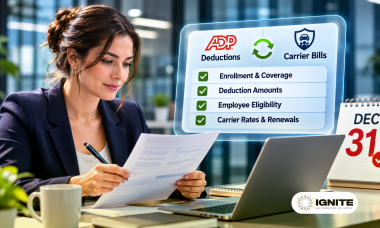
Benefits reconciliation, done before December 31, is the work of making what ADP deducts match what your carriers bill, employee by employee, plan by plan. It's not glamorous. It's also one of the highest-return hours your team can spend this quarter, because every dollar of mismatch is either your company's money leaking out or your employees' money sitting in the wrong place.
Deduction-to-carrier gaps aren't caused by incompetence. They're caused by timing. Payroll and carriers run on different clocks. An employee is termed in ADP on the 15th, but the carrier processes the termination on the 1st of the next month, and bills for the gap. A new hire's coverage is effective on day one, but their first deduction lands a pay period later. A qualifying life event changes coverage mid-month, and the carrier and payroll pro-rate it differently, or one of them doesn't pro-rate it at all.
Layer in the ordinary chaos of a year: employees on leave whose deductions paused, rate changes that hit one system but not the other, a plan code remapped during a renewal, COBRA participants drifting between lists. None of these is dramatic. All of them are cumulative. A company that hasn't reconciled since last January is typically carrying dozens of small discrepancies, and a few of them are usually not small at all.
The direct cost comes in two flavors. When the carrier bills more than payroll collected, the company has been quietly subsidizing coverage: paying premiums for people who should have been termed, or covering gaps employees were never charged for. Those dollars rarely come back; most carriers limit how far back they'll credit, often to just a month or two (check your carrier contracts for the exact window), so every month of delay converts recoverable money into a write-off. When payroll collected more than the carrier billed, you're holding employees' money for coverage they're not getting, which is a refund obligation, an awkward conversation, and in the case of pre-tax deductions, a tax correction on top.
The indirect cost is worse. An employee who was dropped by the carrier but still deducted finds out at the pharmacy counter. A dependent who should have been removed drives claims the carrier may later unwind. And once the new plan year's rates are flowing, every uncorrected prior-year discrepancy contaminates the new year's reconciliation too, which is how companies end up with mismatches nobody can explain that are three plan years old.
A real reconciliation is more than eyeballing the invoice total against the deduction register. Totals can match while being wrong in both directions, with an over here canceling an under there. The work is a person-level and plan-level comparison across every benefit with money moving, including:
Those are the headline categories. The full scope, including the populations that hide discrepancies, like terms, new hires, leaves, and COBRA, is laid out in the Ignite HCM Year-End Checklist (ignitehcm.com/yearend-guide). The deliverable you're after is simple to state: a defensible statement that as of December 31, every person being billed is being deducted, every person being deducted is being covered, and the amounts agree.
Here's the uncomfortable truth about January discrepancies: most of them were created in November and December. Open enrollment is a massive data handoff. Elections move from an enrollment experience into ADP Workforce Now, and from there out to carriers, and every hop is a chance for a dropped election, a stale rate, or a mapping error. An employee who switched from single to family coverage, a new plan option added this year, a carrier change for dental: these are the records that go wrong.
Reconciling before December 31 does double duty here. It cleans up 2026, and it establishes a verified baseline right before the new elections land. When January's first invoices arrive, you can compare them against a known-good December instead of against a pile of unresolved history. Companies that skip this step spend the first quarter unable to tell which mismatches are new enrollment errors and which are old ghosts, and end up investigating both at once.

Three clocks are running. Carrier credit windows limit how far back billing errors can be recovered, so delay converts errors into losses. The plan year boundary scrambles the evidence, because after January 1 you're reconciling across two rate structures instead of one. And pre-tax deduction errors that cross a calendar year can create payroll tax corrections that are far messier to fix in a closed year than an open one.
There's also a simple capacity argument. Your benefits and payroll people have more ability to chase a discrepancy in early December than they will at any point in Q1, when W-2s, new-year payrolls, and enrollment fallout own their calendars. The reconciliation doesn't get easier by waiting. It only gets more expensive.
A version of this lands on our desk every January: a company of a couple hundred employees that hasn't reconciled benefits in over a year. When the comparison finally runs, the headline finding is a list of terminated employees still active on the medical carrier's bill, some for most of a year. The premiums paid for people who no longer work there add up to a painful five-figure sum, and because the carrier's retroactivity policy allows credits going back only a couple of months, most of it is premium dollars that are simply gone. On the other side of the ledger, a handful of active employees have been under-deducted for family coverage all year, forcing a choice between absorbing the shortfall and clawing back a year of missed premiums from employees in January. Most companies absorb it. Almost all of it is preventable with a monthly habit and a December deadline.
Matching totals are weaker evidence than they feel like. Overs and unders offset each other in a total, and employer-paid portions can mask employee-level errors. If nobody has compared person-by-person this year, assume discrepancies exist, because at almost every company that hasn't reconciled, they do.
Early December at the latest. You need the current carrier bills in hand, time to investigate what the comparison surfaces, and runway to make corrections while 2026 payrolls are still running. Starting the week of the 29th is how reconciliations slide into January and lose their value.
Unrecoverable premium overpayments as carrier credit windows close, refund and tax-correction obligations for over-deducted employees, coverage surprises for people whose records are wrong, and a 2027 reconciliation that starts contaminated, which makes next year's version of this problem bigger and blurrier.
Ignite HCM is made up of former ADP service professionals, and we work with ADP clients exclusively. We've reconciled ADP Workforce Now deductions against just about every carrier format there is, and we know where the money hides. No ticket queue, no starting over with a new rep every call, just a dedicated consultant who owns it with you until the numbers tie. Hair on fire? Call us.
Year-end is won in November, not January. Grab the free Ignite HCM Year-End Checklist or REQUEST A CONSULTATION and we'll run it with you.
ADP and the ADP logo are registered trademarks of ADP, Inc. This article is general guidance, not tax, legal, or benefits-compliance advice. Confirm your specific situation with your licensed advisor.