Ask any payroll professional which run of the year scares them most, and you'll get the same answer: the first one. Not because it's bigger or more complicated on its face, but because everything underneath it has changed. Tax tables, wage bases, contribution limits, benefit rates, pay calendars, and a hundred quiet system settings all reset or shift at the year boundary. The first payroll of 2027 is a brand-new machine making its maiden run, and most companies fire it up cold on January 2 with half the team still on holiday.
When that run goes wrong, it goes wrong publicly. Wrong net pay in the first check of the year is how employees start their year. Wrong deductions mean benefits corrections that drag on for months. Wrong tax setup means amended filings later. And unlike a mid-year mistake, a first-run mistake happens when your ADP service team, your benefits broker, and your own staff are all at their maximum stretched, because everyone else's year just rolled over too.
Here's the thing the veterans know: the first payroll of 2027 isn't a January event. It's a December project with a January deadline. Everything that can be staged, verified, and tested ahead of time should be. What follows is what changes at the boundary, why the first run fails more than any other, and what belongs on your December staging list.
January 1 is the great reset. Every employee's year-to-date wage counters go back to zero, which restarts Social Security withholding for anyone who maxed out in 2026, and the ceiling itself moves: the official 2027 Social Security wage base is $192,300. Retirement contribution limits reset too. The IRS hasn't announced official 2027 retirement plan limits yet; current projections point to $25,500 for employee deferrals with an $8,500 catch-up, but treat those as projections until the IRS speaks. HSA limits for 2027 are official: $4,500 for self-only coverage and $9,000 for family coverage.
Every one of those numbers touches payroll. Employees who front-load retirement contributions, employees near the wage base, employees who elected new HSA amounts at open enrollment: all of them need the right 2027 limits governing their first check. A limit that's stale by one year doesn't announce itself. It just quietly caps or fails to cap, and you find out at year-end 2027.
New year, new tax tables. Federal withholding tables update, state tables update, and state unemployment insurance rates arrive in the mail all winter, each with its own effective date. Local taxes shift too, and minimum wage increases on January 1 in many states ripple into rates and overtime calculations. Employer-side taxes restart their own wage bases, which changes the company's cash needs in Q1 even if nothing else moved.
Most of this flows into ADP Workforce Now through updates, but "flows in" is not the same as "verified." SUI rate notices in particular are notorious: they arrive addressed to someone who left, sit in a pile, and the old rate keeps calculating until the mismatch surfaces as a tax notice. Confirming what changed, what should have changed, and what actually changed in the system is the work. December is when that confirmation is cheap.
For most companies, the benefit elections employees made at open enrollment take effect January 1, which means the first payroll of 2027 is also the first live test of your entire open enrollment data flow. New plans, new rates, new elections, new dependents, dropped coverage, changed FSA and HSA amounts: all of it has to be sitting in the payroll system, correct, before that run processes.
This is where first runs break most often, in our experience. An election that didn't flow from the enrollment system, a rate table loaded with last year's premiums, a new plan code nobody mapped: each one turns into a wrong deduction on a very visible check. And benefits deduction errors compound, because every pay period that passes before the catch adds another correction, another arrears calculation, another awkward employee conversation.
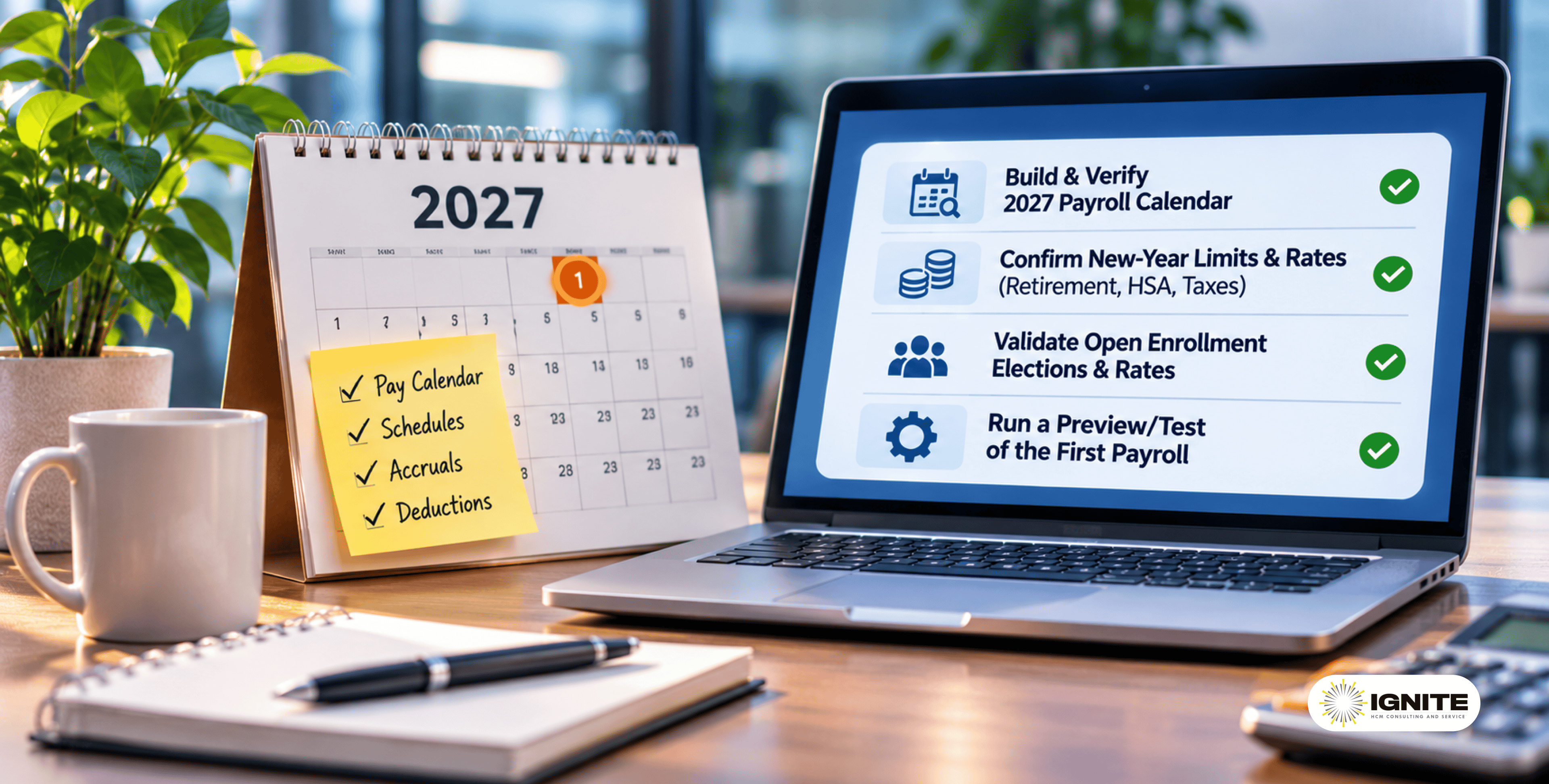
The unglamorous layer causes a shocking share of first-run failures. Pay calendars for 2027 have to exist and be right, including how holidays shift processing and check dates in the first week of the year. Payroll schedules, accrual resets, goal amounts that restart, and deduction schedules all need a deliberate look. If the company is changing anything structural, like pay frequency or a new earnings policy, the year boundary is when it goes live, and it had better have been tested before it does.
The December staging list is longer than most teams expect. At minimum, it includes:
The complete staging list, in the order we actually work it with clients, is in the Ignite HCM Year-End Checklist (ignitehcm.com/yearend-guide).
The first run of the year fails most often for a simple reason: it's the only payroll of the year where dozens of independent changes all activate at once, and it's processed at the moment of lowest organizational attention. Support queues everywhere are at their longest. Your own payroll team is simultaneously closing 2026, answering W-2 questions, and chasing the January 1 compliance changes. There is no slack in the system to absorb a surprise.
Staging in December converts surprises into checklist items. A wrong benefit rate found in a December preview costs ten minutes. The same wrong rate found after the January run costs a correction cycle, an employee communication, and sometimes a refund or arrears process stretched across multiple checks. Same error, wildly different price, and the only variable is when you found it.
Here's how this usually goes. A company with a few hundred employees runs its first payroll of the new year with the prior year's benefit rates still loaded. Open enrollment data had been exported, but the new rate tables were never finalized in the system, and nobody previewed the run. A large share of the workforce is under-deducted for medical premiums in the first two checks of January. The shortfall owed to the carrier runs well into five figures, and recouping it means doubled-up deductions through February and March, a wave of complaints, and a few employees who have already left and can't repay at all. Add the staff hours spent reconciling every affected employee, and a problem a one-hour December preview would have caught becomes a quarter-long cleanup and a full quarter of lost goodwill.
A clean first run last year mostly tells you last year's changes landed. Every year boundary brings a fresh set: different limit changes, a different open enrollment, new tax rates, maybe new plans or policies. The risk resets annually, just like the wage bases do.
Realistically, the first half of December. You need time to build the 2027 calendar, land open enrollment data, confirm rates and limits, and still have room to preview the run and fix what the preview finds before the holidays swallow everyone.
Depending on what broke: wrong net pay on the most-watched check of the year, premium shortfalls owed to carriers, missed or excess retirement and HSA contributions to unwind, tax under-withholding that surfaces as notices later, and weeks of correction work in the quarter when payroll teams can least afford it.
Ignite HCM is staffed by former ADP service professionals who have shepherded hundreds of first payrolls through ADP Workforce Now, and we serve ADP clients exclusively. We know what resets, what breaks, and what a December preview needs to prove before anyone relaxes. No ticket queue in the worst week of the year, just a dedicated consultant working your run with you. We've got you.
Year-end is won in November, not January. Grab the free Ignite HCM Year-End Checklist (ignitehcm.com/yearend-guide) — or REQUEST A CONSULTATION (ignitehcm.com/solutions/payroll-processing) and we'll run it with you.
ADP and the ADP logo are registered trademarks of ADP, Inc. This article is general guidance, not tax or legal advice. Confirm limits, rates, and requirements for your situation with your licensed advisor.