On January 1, minimum wage goes up in a long list of states, counties, and cities, all at once, all at midnight. It happens every year, and every year a surprising number of employers find out in mid-January that somebody's rate didn't get updated. Not because anyone was careless, but because the people who manage rates were buried in year-end closeouts, W-2 prep, and open enrollment cleanup when the change took effect.
Here's the uncomfortable math. If an employee's rate should have gone up on January 1 and it didn't, every hour they work in the new year accrues back pay from hour one. There's no grace period. A two-week delay across a handful of hourly employees is an annoying correction. A six-week delay across three states and two city ordinances is back pay, potential penalties, and in some jurisdictions, damages on top of the wages themselves.
The good news: this is one of the most preventable compliance misses in all of payroll. The rates are published in advance. The effective date is known. The work is identifying who's affected and getting new rates staged in ADP Workforce Now before the first payroll of 2027 runs. The hard part is doing it in November and December, when nobody has spare time. Which is exactly why it slips.
Minimum wage increases don't phase in. The old rate is legal on December 31 and illegal on January 1. If your first pay period of 2027 straddles the year boundary, as most do, you may even need different rates for different days within a single period, depending on the jurisdiction. That's the kind of detail that gets missed when rate updates happen "whenever we get to January."
And this isn't one deadline. It's dozens of overlapping ones. State minimums, county ordinances, city ordinances, and industry-specific rates can all move on the same date, and an employee is owed the highest rate that applies to where they actually work. A company with locations, or remote hourly workers, in multiple states isn't tracking one change. It's tracking a matrix.
The obvious group is employees sitting exactly at the current minimum. But the exposure is wider than that. Employees earning slightly above the old minimum can fall below the new one overnight; someone at $15.25 is fine until the local floor becomes $15.50. Tipped employees carry their own risk, because tipped minimums and tip credit rules shift too, and the math connecting cash wage, tip credit, and total compensation has to keep working under the new numbers.
Then there's the group almost everyone forgets: salaried exempt employees. In some states, the salary floor for exempt status is tied to the minimum wage, so when the minimum rises, the exempt salary threshold can rise with it — confirm the rules for your states with your advisor. An exempt manager whose salary quietly slips below the new threshold isn't exempt anymore, which means overtime eligibility you didn't plan for and misclassification exposure you really didn't plan for.
Multi-state employers feel all of this at once. So do employers with remote hourly staff, because the rate that applies is generally driven by where the employee works, not where the company is headquartered.
When people hear "minimum wage increase," they picture one number on a poster. The actual review covers several categories, each with its own failure mode. At minimum, the sweep includes:
That's the short version. The full review, including the pay-practice questions each category raises, is laid out in the Ignite HCM Year-End Checklist (ignitehcm.com/yearend-guide).
There's a second-order effect worth naming too: compression. When the floor moves up, the people one or two dollars above the floor notice that new hires are suddenly earning almost what they earn. That's not a compliance problem, but it is a retention problem, and smart employers decide in December how they'll handle it rather than improvising in February when the grumbling starts.
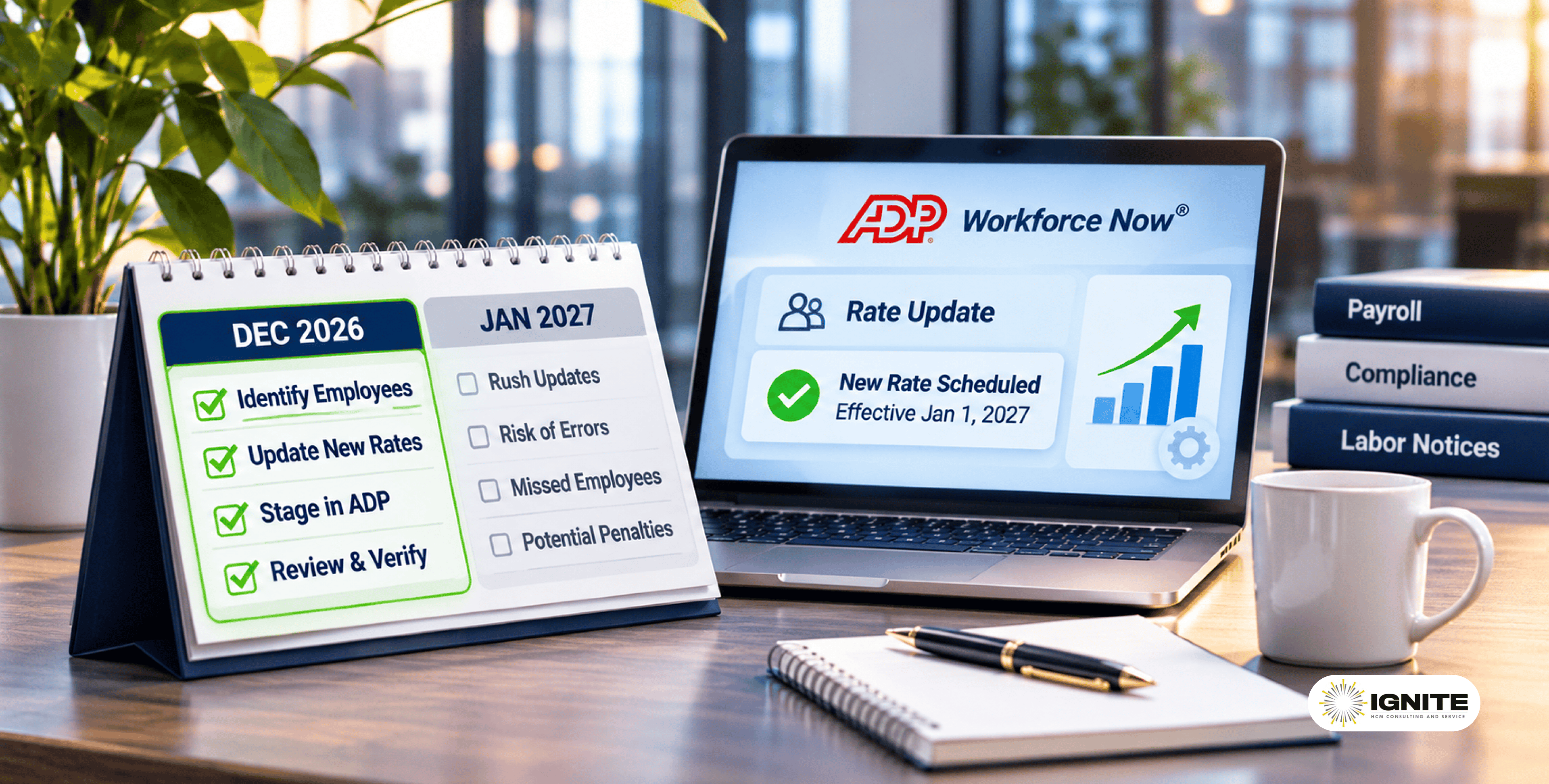
The rates don't change themselves. ADP Workforce Now will calculate exactly what it's told to calculate, and if an employee's rate still says 2026 on January 3, the system will happily pay them the 2026 rate. The work is identifying every affected employee, confirming the correct new rate for their actual work location, and staging those changes with the right effective dates so the first run of the new year picks them up automatically.
Staging matters more than people think. Rate changes entered in a rush during the first week of January compete with every other first-of-year task, and rushed entry is where typos, wrong effective dates, and missed employees come from. Changes staged in December get reviewed calmly, checked against the published rates, and verified before anything pays out. There's also the poster-and-notice side of the house: several jurisdictions require updated wage notices or postings when rates change, and those carry their own penalties when skipped.
Back pay is the headline cost, and it's the cheapest part. Every underpaid hour has to be recalculated and paid, usually with a correction run that itself takes time and money. Some jurisdictions add liquidated damages or penalties per employee per pay period on top of the shortfall. Underpaid wages also ripple into everything calculated from wages: overtime rates, taxes, and benefit deductions tied to compensation can all need correcting too.
And there's the quieter cost. Hourly employees know when the minimum wage goes up. It's in the news, it's on the poster in the break room, and it's in the group chat. When their check doesn't reflect it, they notice before HR does, and trust takes a hit that outlasts the correction. Wage complaints to state agencies very often start exactly this way.
A typical case: a restaurant group runs locations in three states, two of which raise rates on January 1. The payroll manager leaves in December, the updates sit half-finished, and the first several payrolls of the new year go out at old rates for dozens of hourly and tipped employees. The back pay alone runs well into five figures, and state penalties and damages in one of the jurisdictions pile on top of it. The correction runs, the recalculated overtime, and the amended filings consume most of February, and a couple of employees file state wage complaints that keep the file open well into spring. A missed effective date becomes weeks of cleanup, a bill that dwarfs what the December staging would have cost, and a season of distraction.
Yes, because exposure doesn't scale down the way you'd hope. Back pay plus penalties on even three or four underpaid employees adds up fast, and small employers are not exempt from wage enforcement. The review is also fastest for small teams, so the cost of doing it right is lowest exactly where the excuse is most tempting.
Before the first payroll of 2027 is processed, with effective dates that match each jurisdiction's rules. Practically, that means the research and staging work belongs in November and December, so the first run of the year is a verification exercise, not a scramble.
Every underpaid hour from January 1 forward: back wages, possible liquidated damages and penalties depending on the state, correction runs, amended filings, and the real chance an employee files a complaint before you catch it yourself. The meter starts at midnight on New Year's Eve whether you're ready or not.
Ignite HCM is built from former ADP service professionals, and we support ADP clients exclusively. We've staged January 1 rate changes across multi-state, tipped, and remote workforces more times than we can count, and we know exactly how these updates should land in ADP Workforce Now. No ticket queue, no waiting on hold in the busiest week of the year, just a dedicated consultant who treats your deadline like their own. Your people need to get paid. We make that happen.
Year-end is won in November, not January. Grab the free Ignite HCM Year-End Checklist (ignitehcm.com/yearend-guide) — or REQUEST A CONSULTATION (ignitehcm.com/solutions/compliance) and we'll run it with you.
ADP and the ADP logo are registered trademarks of ADP, Inc. This article is general guidance, not legal or tax advice. Confirm the rules for your jurisdictions with your licensed advisor.