In today's fast-paced, technology-driven workplace, employees expect instant access to information and support to do their jobs effectively. At the same time, HR and IT teams are stretched thin trying to keep up with an endless stream of requests and inquiries.
Enter conversational AI—intelligent digital assistants that go beyond simple chatbots to engage employees in truly helpful, human-like interactions. By leveraging natural language processing, machine learning, and vast knowledge bases, these AI-powered tools are transforming how companies deliver always-on employee support.
At its core, conversational AI refers to software that can engage in dialogue with humans using natural language. Most of us are familiar with virtual assistants like Siri or Alexa. Conversational AI powers these tools, allowing them to understand questions phrased in everyday language, maintain context over the course of a conversation, and provide relevant, personalized responses.
Under the hood, conversational AI platforms rely on several key technologies:
Natural Language Processing (NLP): Allows the AI to parse human language, extracting meaning and intent from text or voice inputs. NLP handles tasks like named entity recognition, sentiment analysis, and topic classification.
Machine Learning: Algorithms that allow the AI to learn and improve over time based on data and interactions. Techniques like deep learning enable AI to discover patterns, optimize responses, and adapt to each user.
Dialog Management: The brains of the operation, dialog management defines conversation flows, handles contextual understanding, and coordinates responses across multiple skill domains. More advanced systems can juggle context switches, clarifications, and non-linear conversation paths.
Knowledge Bases: Expansive, organized collections of data the AI can draw upon to answer questions and inform responses. May include structured databases, unstructured documents, FAQs, and web content.
When an employee interacts with a conversational AI tool, here's what happens behind the scenes:
This all happens in a matter of milliseconds, allowing for fluid, real-time interactions. With each conversation, the AI collects more data that helps it learn and optimize its performance over time.
So how are forward-thinking organizations putting conversational AI to work for their employees? Leading solutions go way beyond simple chatbots to provide intelligent, omnichannel support experiences.
One of the most impactful applications of conversational AI is equipping employees with 24/7 access to information. Whether it's an HR query about benefits, an IT question about resetting a password, or a search for the latest sales deck, intelligent assistants connected to company knowledge bases can deliver instant answers.
The beauty of conversational AI in this context is that employees don't need to scour FAQs, submit tickets, or wait on hold to get support. They can simply ask their question in natural language—just as if they were messaging a colleague—and receive an immediate, tailored response.
Advanced solutions take it a step further, proactively surfacing related content and offering contextual guidance. For example, if an employee asks about the 401(k) program, the AI might provide links to enroll, adjust contributions, or book time with a financial advisor. By anticipating needs and making personalized recommendations, these tools empower employees to find what they need and take action in the moment.
Conversational AI isn't just for answering questions—it can also guide employees through complex workflows and help complete tasks end-to-end. By integrating with enterprise systems like HR, finance, and IT service management platforms, intelligent assistants can transact on the employee's behalf.
Say an employee wants to request PTO. Rather than navigating to the HR portal, filling out a form, and waiting for approvals, they could simply tell the AI assistant, "I need to take next Friday off." The bot would then:
All of this can be accomplished conversationally, with the employee answering clarifying questions and providing additional details as needed along the way. The same approach applies to any number of routine workflows—filing expenses, provisioning software, ordering equipment, and so on.
By offloading these time-consuming tasks and processes to AI, companies can boost employee productivity, reduce support costs, and ensure nothing falls through the cracks. And employees are freed up to focus on higher-value work.
Another key advantage of conversational AI is the ability to deliver timely, relevant information and nudges to employees on an individual basis. By tapping into employee data and applying machine learning insights, intelligent assistants can anticipate needs and engage proactively.
Some examples:
These proactive touchpoints—delivered at scale and powered by data—help keep employees informed, supported, and engaged throughout their journey. HR teams often struggle to provide this level of personalized attention, but conversational AI makes it possible to do so efficiently and consistently.
Today's workforce is more global and distributed than ever. Conversational AI platforms with multilingual NLP capabilities allow companies to provide the same high level of support to employees regardless of location or native language.
Advanced AI can engage with employees in their preferred language, understanding and responding in kind. This ensures all workers feel included and have equal access to information—fostering belonging and productivity across borders.
What's more, the best conversational AI tools offer omnichannel experiences—meeting employees where they are across web, mobile, messaging apps, and voice interfaces. Employees can pick up the conversation where they left off as they move between devices and channels throughout the day.

While the benefits are significant, implementing conversational AI for employee support requires careful planning and execution. Some key considerations:
Start by identifying the highest-impact use cases based on employee needs and business objectives. Common scenarios include:
Design conversations and workflows to make employee tasks faster and easier. Focus on quick wins to prove value before expanding into more complex processes.
The success of your conversational AI largely depends on the quality of your knowledge base. Audit existing content for accuracy, consistency and relevance. Identify gaps and create new content as needed to address key queries.
Establish governance and maintenance processes to keep knowledge current over time. The AI will only be as reliable as the data that powers it.
To deliver personalized responses and transactional capabilities, your conversational AI platform needs secure integrations with backend systems like HRIS, ITSM, LMS, and more.
Consider how you will authenticate employees and protect sensitive data. Many solutions offer pre-built connectors and APIs to simplify integrations with leading enterprise software.
To drive adoption, promote the AI assistant as a user-friendly way to get fast help. Position it as an intelligent companion that allows instant self-service across devices.
Make it easy for employees to invoke the bot and pick up where they left off. Ensure conversations feel natural, not overly robotic or restrictive. Apply machine learning to personalize experiences based on employee roles, preferences and behaviors over time.
Establish KPIs to gauge the impact of your conversational AI. Track operational metrics like engagement rates, handle times and resolution rates. Gather qualitative feedback through surveys and sentiment analysis.
Analyze conversation transcripts to identify areas for optimization. Use these insights to continually fine-tune dialogs, expand knowledge and improve the employee experience.
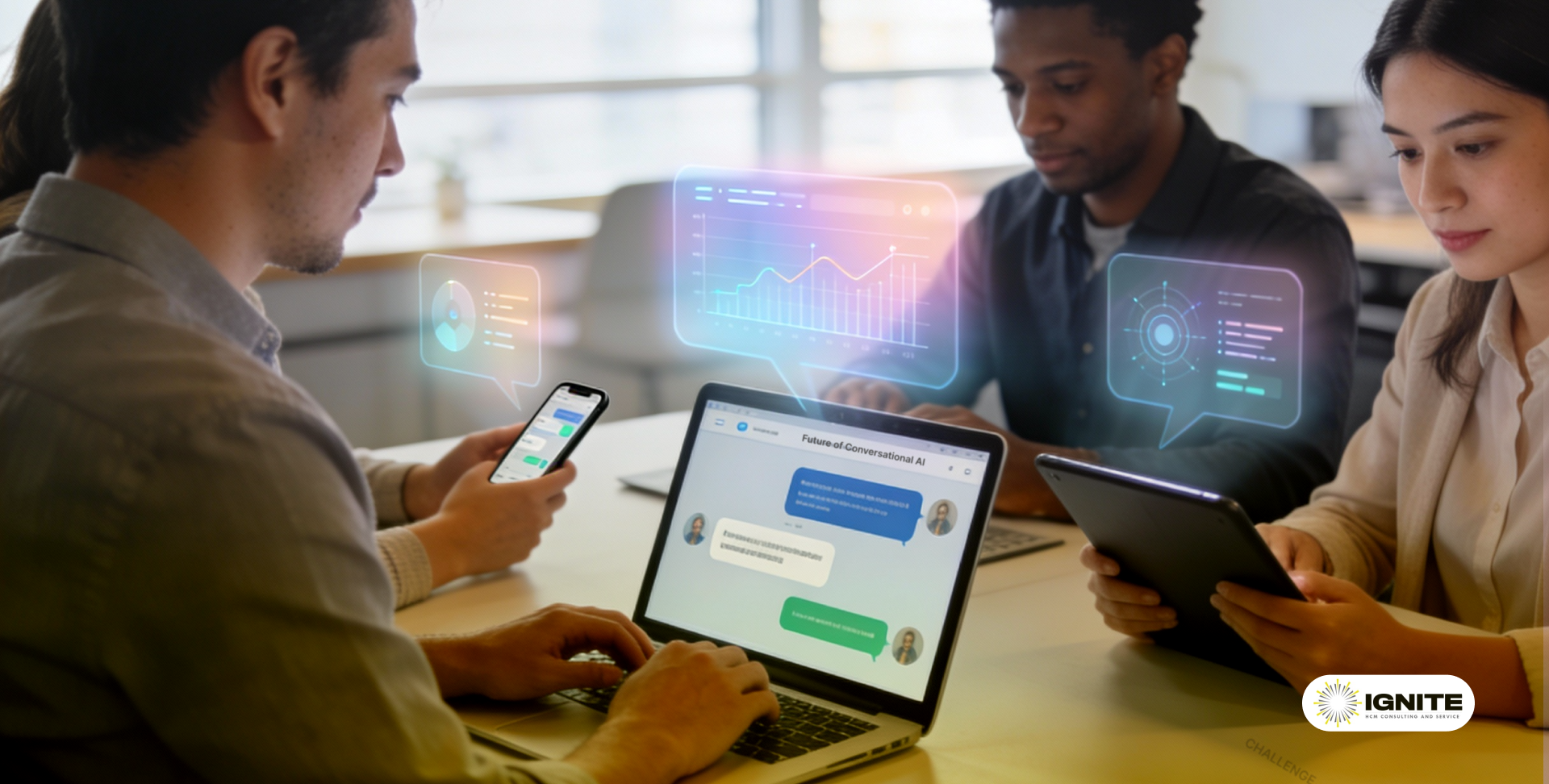
As conversational AI tools become more sophisticated, their potential to transform employee support only grows. Some exciting developments on the horizon:
Advances in machine learning will allow conversational AI to become hyper-personalized to each employee's unique needs, behaviors and preferences. Imagine an AI assistant that:
By combining employee data with AI insights, organizations will be able to provide deeply customized experiences at scale—making each worker feel truly seen and supported.
Conversational AI will increasingly be used to help employees make better decisions in the flow of work. Rather than just providing information, AI assistants will serve up relevant data points, walk through trade-offs and offer personalized recommendations.
Say an employee is trying to decide between two health plans. The AI could fetch plan details from the benefits system, collect a few key inputs from the employee (e.g. expected medical needs, risk tolerance), and provide a data-driven recommendation with rationale.
By embedding this kind of contextual, AI-powered decision support into employee journeys, companies can drive smarter choices and better outcomes across the board.
As conversational AI platforms ingest more employee data over time, they will be able to identify patterns and anomalies that signal potential issues before they escalate.
For example, if the AI detects a spike in questions about a particular IT system, it could proactively alert the service desk of a possible outage. Or if sentiment analysis reveals growing frustration with a new HR policy, the AI could notify leaders and recommend steps to address concerns.
This type of predictive intelligence will allow companies to get ahead of employee pain points and take proactive action to support the workforce.
Looking further out, conversational AI will increasingly facilitate human-to-human collaboration and knowledge sharing across the enterprise. Imagine an intelligent assistant that:
By serving as a smart intermediary, conversational AI can break down silos, foster serendipitous connections, and help employees tap into collective intelligence to solve problems and drive innovation.
In a world where employee expectations are rising and support teams are strapped for resources, conversational AI offers a powerful solution. By engaging employees in natural, personalized dialog, these intelligent tools can deliver the fast, frictionless support experiences workers crave—while freeing up human teams to focus on higher-value work.
But the potential of conversational AI goes far beyond basic Q&A and task completion. As the technology advances, it will increasingly be used to guide decisions, surface insights, and facilitate collaboration—becoming a true copilot for employees in their day-to-day work.
The organizations that harness this potential will be primed to boost employee productivity, engagement and business performance. And they'll be laying the groundwork for the future of work—one in which human and machine intelligence combine to achieve breakthroughs we can only imagine.
Ready to transform employee support? Discover how conversational AI can deliver instant, personalized assistance at scale.