
In today's rapidly evolving technological landscape, the integration of artificial intelligence (AI) into the workforce has become a topic of great interest and debate. As businesses strive to stay competitive and adapt to the changing needs of the market, the concept of AI-human collaboration has emerged as a promising solution. This article explores the various models of AI-human collaboration and provides insights into designing effective augmented workforce strategies.
Before delving into the different collaboration models, it is essential to understand what AI-human collaboration entails. At its core, AI-human collaboration involves leveraging the strengths of both artificial intelligence and human intelligence to achieve better outcomes than either could achieve alone. This symbiotic relationship aims to enhance productivity, efficiency, and decision-making by combining the speed and accuracy of AI with the creativity, empathy, and contextual understanding of humans.
AI excels at processing vast amounts of data, identifying patterns, and performing repetitive tasks with high accuracy. It can quickly analyze complex datasets, make predictions, and automate routine processes. On the other hand, human intelligence brings a unique set of skills to the table. Humans possess the ability to think critically, adapt to new situations, and make judgments based on experience and intuition. They excel at tasks that require creativity, empathy, and emotional intelligence.
By combining the strengths of AI and human intelligence, organizations can create a powerful synergy that drives innovation and enhances overall performance. AI can handle the heavy lifting of data analysis and routine tasks, freeing up human workers to focus on higher-level, strategic responsibilities. This collaboration allows businesses to make data-driven decisions while still incorporating the human touch that is essential for building trust and fostering customer relationships.
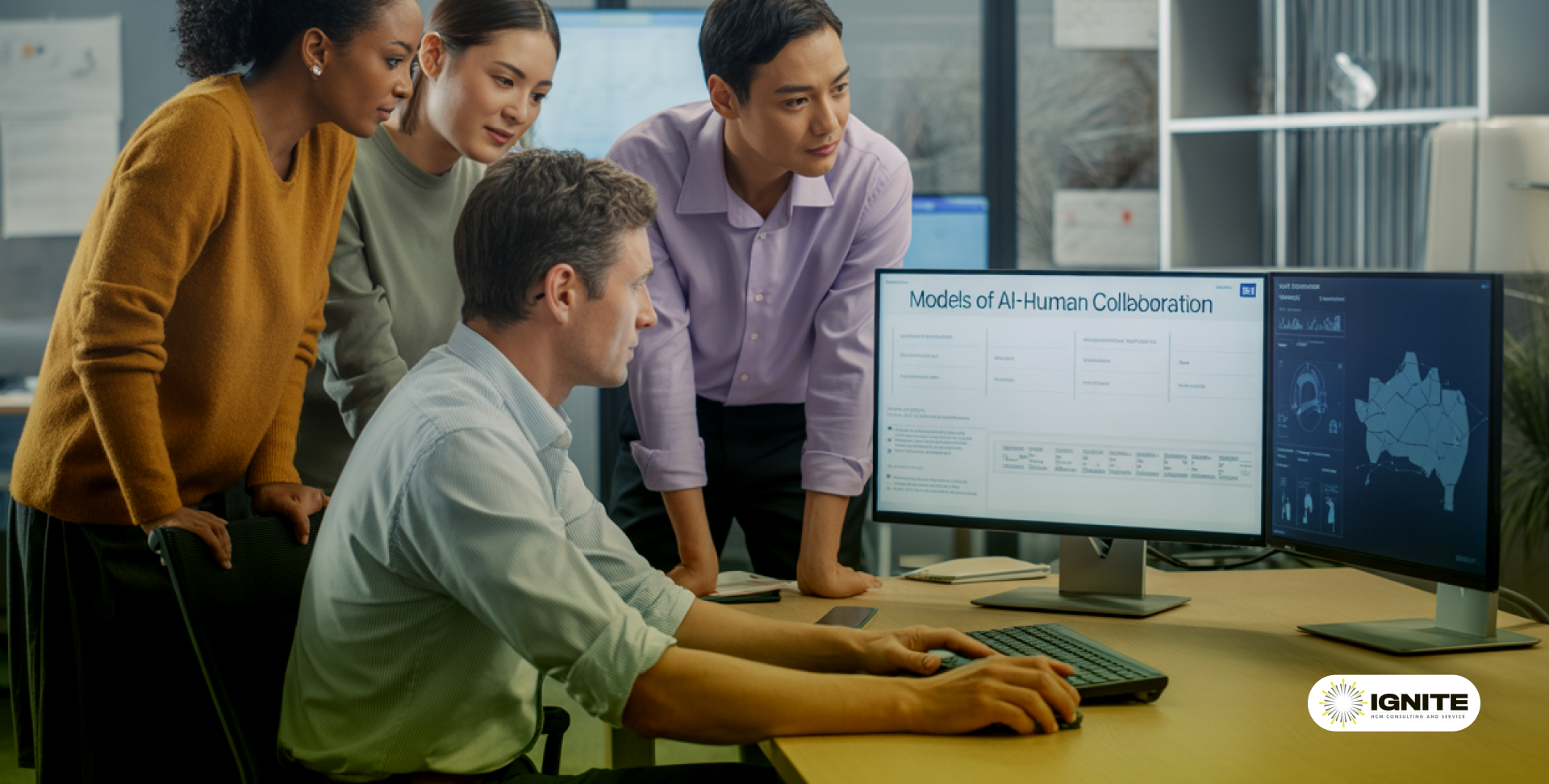
There are several models of AI-human collaboration that organizations can adopt based on their specific needs and goals. Each model offers unique benefits and challenges, and the choice of model depends on factors such as the nature of the task, the level of automation desired, and the skills of the human workforce.
In the assistive AI model, artificial intelligence serves as a supportive tool for human workers. AI assists humans in performing their tasks more efficiently and accurately by providing relevant information, recommendations, and insights. This model is particularly useful in industries where human expertise and judgment are crucial, such as healthcare, finance, and customer service.
For example, in healthcare, AI can analyze patient data and provide physicians with personalized treatment recommendations. However, the final decision still lies with the human doctor who can consider the patient's unique circumstances and preferences. Similarly, in customer service, AI-powered chatbots can handle routine inquiries and provide quick answers, while human agents step in for more complex or sensitive issues.
The assistive AI model enhances human capabilities without replacing human workers. It allows humans to focus on tasks that require higher-level thinking and decision-making while AI takes care of the repetitive and time-consuming aspects of the job.
The collaborative AI model takes the integration of AI and human intelligence a step further. In this model, AI and humans work together as equal partners, each contributing their unique strengths to solve complex problems and make better decisions. The collaborative model is particularly useful in domains where the tasks are too complex for either AI or humans to handle alone.
For instance, in the field of scientific research, AI can analyze vast amounts of data and identify potential hypotheses, while human researchers can use their domain expertise to validate and refine these hypotheses. In the creative industries, such as advertising or product design, AI can generate multiple design options based on predefined parameters, while human designers can select and refine the most promising ideas.
The collaborative AI model requires a high level of trust and communication between AI and human workers. It involves designing interfaces and workflows that facilitate seamless interaction and enable both parties to learn from each other. The success of this model depends on the ability to create a shared understanding of goals, roles, and responsibilities.
The autonomous AI model involves delegating certain tasks entirely to AI systems with minimal human intervention. This model is suitable for tasks that are highly repetitive, data-intensive, and have well-defined rules and outcomes. Examples include automated manufacturing, supply chain optimization, and fraud detection.
In the autonomous AI model, human workers are primarily responsible for setting the goals, defining the parameters, and monitoring the performance of the AI system. They intervene only when necessary, such as when the AI encounters an exceptional situation or when the goals need to be adjusted.
While the autonomous AI model can lead to significant efficiency gains and cost savings, it also poses challenges in terms of job displacement and the need for reskilling human workers. Organizations adopting this model must carefully consider the ethical implications and ensure that the benefits of automation are distributed fairly across the workforce.

To successfully implement AI-human collaboration and create an augmented workforce, organizations need to design comprehensive strategies that address the technical, organizational, and human aspects of the transition. Here are some key considerations for designing effective augmented workforce strategies:
Not all tasks are suitable for AI-human collaboration. Organizations must carefully analyze their business processes and identify the tasks that can benefit most from the integration of AI. Factors to consider include the complexity of the task, the level of human judgment required, the availability of data, and the potential for automation.
"The key to successful AI-human collaboration is to focus on tasks that play to the strengths of both AI and humans. By leveraging the speed and accuracy of AI for routine tasks and the creativity and empathy of humans for complex decisions, organizations can create a powerful synergy that drives innovation and performance." - Dr. Sarah Johnson, AI Researcher and Consultant
The introduction of AI into the workforce requires a significant investment in training and reskilling programs. Human workers need to be equipped with the skills and knowledge necessary to work effectively with AI systems. This includes understanding the capabilities and limitations of AI, learning how to interpret and act on AI-generated insights, and developing the ability to collaborate with AI as a partner.
Organizations should provide ongoing training and support to help workers adapt to the changing nature of their roles. This may involve workshops, online courses, and on-the-job training programs that focus on both technical skills and soft skills such as communication, problem-solving, and adaptability.
The success of AI-human collaboration depends on building a culture of trust and open communication. Human workers must feel that they are valued partners in the collaboration process and that their contributions are recognized and rewarded. This requires transparent communication about the goals and expectations of the collaboration, as well as regular feedback and support.
Leaders play a crucial role in fostering a positive culture by modeling collaborative behaviors, encouraging experimentation and risk-taking, and celebrating successful collaborations. They must also address any concerns or fears that workers may have about the impact of AI on their jobs and provide reassurance and support throughout the transition.
To facilitate seamless collaboration between AI and human workers, organizations must design intuitive interfaces and workflows that enable easy interaction and information sharing. This involves creating user-friendly dashboards, visualization tools, and communication channels that allow workers to access and act on AI-generated insights in real-time.
The design of these interfaces should be guided by the needs and preferences of the human workers, taking into account their existing workflows and the specific requirements of their roles. Regular user testing and feedback loops can help refine the design and ensure that it meets the needs of both AI and human collaborators.
The deployment of AI in the workforce raises important ethical and governance questions that organizations must address proactively. This includes ensuring that AI systems are transparent, accountable, and unbiased, and that they are used in ways that promote fairness, privacy, and security.
Organizations should establish clear governance frameworks that outline the roles and responsibilities of AI and human workers, as well as the procedures for monitoring and auditing AI systems. They should also develop ethical guidelines that align with their values and ensure that AI is used in ways that benefit society as a whole.
"The ethical use of AI in the workforce is not just a matter of compliance, but a strategic imperative. By prioritizing transparency, accountability, and fairness in their AI deployments, organizations can build trust with their workers, customers, and stakeholders, and create a sustainable competitive advantage." - Mark Thompson, AI Ethics Expert and Author
AI-human collaboration represents a powerful opportunity for organizations to enhance their workforce capabilities and drive innovation in the face of rapid technological change. By designing effective augmented workforce strategies that leverage the strengths of both AI and human intelligence, organizations can create a symbiotic relationship that benefits workers, customers, and society as a whole.
However, the transition to an augmented workforce is not without its challenges. It requires significant investments in training, technology, and organizational change, as well as a commitment to ethical and responsible AI deployment. Organizations that embrace these challenges and approach AI-human collaboration with a spirit of experimentation, empathy, and continuous learning will be best positioned to reap the benefits of this transformative technology.
As we move forward into an increasingly AI-driven future, it is essential that we prioritize the human element in our workforce strategies. By empowering human workers to collaborate with AI as partners, rather than competitors, we can create a more inclusive, innovative, and sustainable economy that works for everyone.
Building an augmented workforce? Discover the collaboration models and strategies you need to successfully integrate AI and human intelligence for maximum impact.
Sources: