Running payroll for a restaurant is its own sport. Tips come in cash and on cards. Servers clock in and out around split shifts. Someone quits on a Tuesday and you've hired two replacements by Friday. On top of all that, you're expected to get tip credits, minimum-wage makeup, and overtime exactly right, every pay period, for a workforce that never stops changing. It's a lot, and the penalties for getting it wrong aren't small.
Most operators we meet aren't worried about the food or the floor. They're worried that a wage-and-hour rule slipped through, that a tipped overtime calculation was off, or that onboarding a new hire took so long they lost the person before the first shift. When your margins are thin and your turnover is high, payroll mistakes hit twice: once in the correction, and again in the time it takes to fix them.
Here's the reassuring part. ADP Workforce Now has the tools to handle tips, tip credits, and fast onboarding well — the trick is setting it up for how restaurants actually run. Below we'll walk through tip reporting, tip credit and minimum-wage makeup, tipped overtime, onboarding and offboarding at speed, and scheduling and time. Your people need to get paid, and paid right. We make that happen.
Tips are income, and they have to be reported and taxed like income. That sounds simple until you remember tips arrive through several doors: cash left on the table, amounts added to a credit card, and pooled tips split among staff. Each one has to land in payroll accurately so withholding and employer taxes are correct.
Employees are generally required to report tips to the employer, and employers withhold on reported tips and pay their share of payroll taxes on them. Card tips usually flow through your point-of-sale system; cash tips depend on employee reporting. If tips aren't captured correctly, you can end up under-withholding, which becomes the employee's problem at tax time and yours at audit time.
The setup that works is a clean connection between your POS or timekeeping and ADP Workforce Now, with the right earnings codes for reported tips, and a consistent process for tip pooling if you use it. When tips flow in cleanly, the rest of the pay calculation has solid ground to stand on. Specific tip-reporting thresholds and rules change, so confirm the current requirements with your advisor.
This is where a lot of restaurants get nervous, and for good reason. In many jurisdictions, employers can pay tipped employees a lower direct cash wage and count a portion of tips toward the minimum wage. That's the tip credit. But there's a catch that trips people up constantly: if an employee's direct wage plus their tips doesn't reach the full minimum wage for the hours worked, the employer has to make up the difference. That's minimum-wage makeup, and it's not optional.
The amounts, the maximum tip credit, and the direct cash wage floor vary by state and sometimes by city, and they change over time. Some places don't allow a tip credit at all. We're not going to quote figures here because the wrong number is worse than no number — check your state and local rules and confirm with a wage-and-hour advisor.
What matters operationally is that your payroll has to check, every pay period, whether each tipped employee cleared the minimum wage once tips are counted. If they didn't, makeup pay has to be added. ADP Workforce Now can be implemented and configured to help surface these situations, but the configuration has to match your specific jurisdiction and pay practices. Getting this monitored automatically, rather than eyeballed, is what keeps you out of trouble.
Overtime for tipped employees is one of the most misunderstood calculations in the whole restaurant world. The common mistake is taking the low direct cash wage and multiplying by 1.5. That's usually wrong.
Overtime is generally based on the full minimum wage or the employee's regular rate, not the reduced direct cash wage, before the tip credit is applied. The mechanics can get detailed, especially when an employee earns different rates for different roles in the same week or when service charges are involved. The result is that tipped overtime almost always comes out higher than operators expect.
Because the rules here are technical and vary by jurisdiction, this is an area to set up carefully and confirm with your advisor. The important thing to know is that if your overtime math starts from the low cash wage, it's probably wrong, and those errors add up fast across a busy schedule.
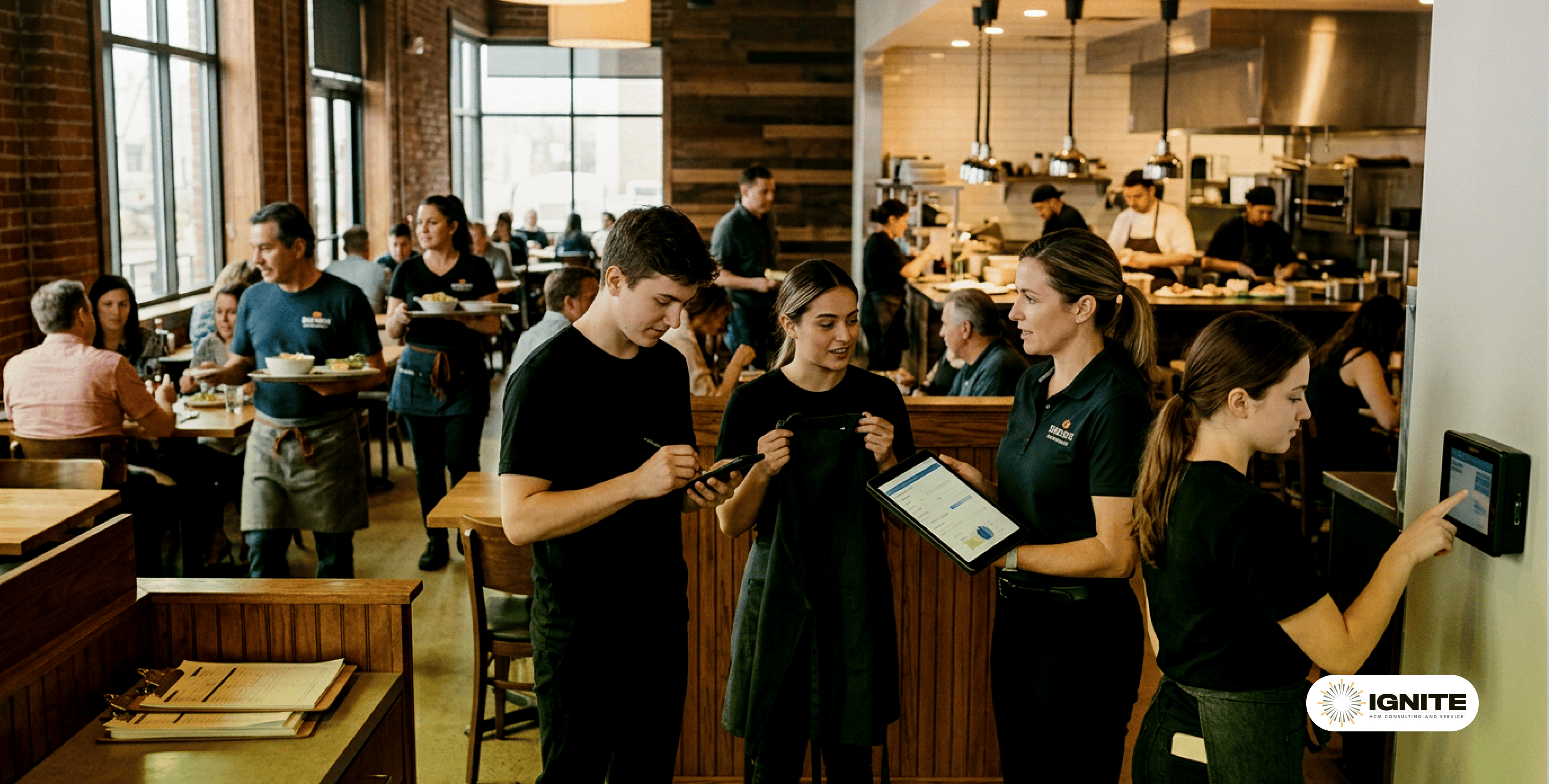
Restaurant turnover is famously high. If it takes a week to get a new hire into the system, you're always behind, and worse, you risk paying someone late — which is a great way to lose them before they ever settle in.
The fix is a fast, repeatable onboarding path in ADP Workforce Now. New-hire self-service lets employees enter their own details, tax elections, and direct deposit on a phone before their first shift. Standard onboarding templates by role mean you're not rebuilding the process for every hire. Electronic tax and I-9 documents cut the paperwork. And a clean feed into scheduling and time means a new server can clock in on day one without anyone scrambling.
Set up well, onboarding a new hire becomes minutes of work, not hours. That speed matters most exactly when you're busiest and hiring hardest.
Offboarding gets less attention than hiring, but it carries real risk. Final pay rules — including how quickly a departing employee must be paid and what has to be included — vary by state, and some are strict. Miss a final-pay deadline and you can face penalties on top of the wages owed.
A tight offboarding process closes out the employee's record, handles the final check on the required timeline, stops benefit deductions correctly, and keeps clean documentation. When people come and go as often as they do in food service, having this run the same way every time protects you. Confirm your state's final-pay timing with your advisor, because those deadlines are unforgiving.
Everything above depends on accurate hours. If time data is messy, tips, tip credits, and overtime all inherit the mess. Scheduling and time tracking that connect to ADP Workforce Now give you a straight line from the shift to the paycheck.
Good time setup captures clock-ins and clock-outs accurately, handles breaks according to your local rules, flags approaching overtime before it happens, and separates hours by role and rate when employees work more than one job. When the schedule, the time clock, and payroll all agree, pay periods stop being a reconciliation exercise and start being routine.
Restaurants add a few wrinkles here that general businesses don't face. A server who covers a bartending shift needs those hours tracked at the bartender rate, not blended into one number. Split shifts, where someone works lunch, leaves, and comes back for dinner, have to be captured cleanly so the day's hours and any premium pay are right. And when you run more than one location, you want time and pay to roll up consistently so a regional view actually means something. Building these patterns into ADP Workforce Now once, instead of correcting them every week, is what turns a chaotic pay period into a quiet one.
A client ran three quick-service locations with heavy turnover and a mix of cash and card tips. Their pain wasn't one big error; it was constant small friction. New hires waited days to get set up. Tipped overtime was being calculated off the low cash wage, so some checks were short. And no one was systematically checking whether tipped staff cleared minimum wage after tips, which left the client exposed on makeup pay.
We reset the foundation. Card tips flowed from the POS into ADP Workforce Now on the correct earnings codes, and cash-tip reporting got a consistent process. We reconfigured overtime to start from the right rate rather than the reduced cash wage. We added a pay-period check to surface any tipped employee who fell short of minimum wage so makeup pay could be added before the run went out. And we built a phone-based onboarding template so a new hire could be ready before their first shift.
Illustratively, onboarding time dropped from a few days to under an hour, and the short-paycheck corrections stopped. The numbers here are rounded and for illustration, but the pattern is one we see often: fix the setup once, and the weekly firefighting fades.
"Do we still owe anything if an employee's tips are low that week?"
Often, yes. If a tipped employee's direct cash wage plus tips doesn't reach the full minimum wage for the hours they worked, you generally have to make up the difference. That makeup pay isn't optional, and the thresholds vary by state and city. Your payroll should check this every pay period rather than assuming tips always cover it. Confirm your local rules with a wage-and-hour advisor.
"How do we calculate overtime for a tipped employee?"
Not by multiplying the low cash wage by 1.5. Overtime is generally based on the full minimum wage or the employee's regular rate before the tip credit is applied, which makes it higher than many operators expect. The details get technical, especially with multiple roles or service charges, so set it up carefully and verify with your advisor.
"Can a new hire really be ready before their first shift?"
Yes. With self-service onboarding in ADP Workforce Now, new hires enter their own information, tax elections, and direct deposit from a phone, and role-based templates handle the rest. Done right, setup takes minutes, so someone can clock in on day one without a scramble.

The restaurants that stop losing sleep over payroll share a few habits. They automate the tip flow so reported tips land correctly without manual re-entry. They monitor minimum-wage makeup every pay period instead of hoping tips covered it. They calculate tipped overtime from the right rate and document how they do it. They make onboarding a phone task so new hires are ready before the floor gets busy. And they run offboarding the same way every time, with final pay on the required timeline.
None of this requires heroics. It requires a setup built for how restaurants actually operate, connected from the schedule through the time clock into payroll. Get that foundation right and high turnover stops being a payroll emergency and becomes just a fact of the business you already know how to manage.
At Ignite HCM, we're former ADP service professionals, and we work with ADP exclusively. We've configured tips, tip credits, tipped overtime, and fast onboarding for operators with the same turnover and the same time pressure you're living with. When you reach out, there's no ticket queue and no hold music — a dedicated consultant who knows your locations picks up. Hair on fire before a pay run? We've got you.
Tired of chasing tip and overtime errors every pay period? REQUEST A CONSULTATION (ignitehcm.com/solutions/optimization).
ADP and the ADP logo are registered trademarks of ADP, Inc. This article is general guidance only and not legal, tax, or wage-and-hour advice. Tip credit, minimum wage, overtime, and final-pay rules vary by jurisdiction and change over time; confirm current requirements with your licensed advisor and official federal, state, and local sources.