Why the companies thriving right now aren't the biggest or the smartest—they're the ones that can pivot on a dime
---
There's a reason some organizations seem to dance through disruption while others stumble and fall. It's not about having the deepest pockets, the fanciest technology, or even the most talented people on paper. The secret sauce? Agility.
Think about it like this: In a world where a global pandemic can shift everyone to remote work overnight, where artificial intelligence can reshape entire industries in months, and where consumer preferences change faster than ever before, the ability to adapt isn't just nice to have—it's everything.
Workforce agility has become the organizational equivalent of a strong immune system. When challenges hit (and they will), agile organizations don't just survive—they often come out stronger. But here's the thing: building this kind of adaptability doesn't happen by accident. It requires intentional design, cultural shifts, and a completely different way of thinking about work itself.
Let's break down exactly what workforce agility means, why it matters more than ever, and how organizations are actually building it into their DNA.
---
At its core, workforce agility is an organization's ability to quickly respond to changes—whether those are market shifts, new technologies, competitive threats, or unexpected crises. But it goes deeper than just reacting fast.
True workforce agility operates on three levels:
Here's a mental model that helps: Think of a traditional organization like a cruise ship. It's impressive, can carry a lot of people, and moves efficiently in calm waters. But try to change direction quickly? Good luck. An agile organization is more like a fleet of speedboats. Each boat can pivot independently, they can coordinate when needed, and the whole fleet can change course almost instantly.
Neither model is inherently better—the cruise ship works great in predictable waters. But we're not living in predictable times anymore.
---

Why has workforce agility gone from a "nice-to-have" to a "must-have"? Several converging forces have made adaptability non-negotiable.
According to the World Economic Forum's Future of Jobs Report, 44% of workers' core skills will change by 2027. That's not a typo—nearly half of what makes employees effective today will need to evolve within just a few years. Technologies like AI, automation, and advanced analytics aren't just creating new jobs; they're fundamentally reshaping existing ones.
Product lifecycles are compressing. Business models that once lasted decades now become obsolete in years. Research from McKinsey shows that the average lifespan of companies on the S&P 500 has decreased from 61 years in 1958 to roughly 18 years today. Organizations that can't evolve simply don't last.
Employee expectations have permanently shifted. People want flexibility, purpose, and growth opportunities. A Gallup survey found that 48% of American workers are actively job searching or watching for opportunities. Organizations that can't adapt to these new expectations will struggle to attract and retain the talent they need.
From supply chain disruptions to inflation to shifting global trade patterns, uncertainty has become the new normal. Companies need workforces that can scale up, scale down, and redeploy resources without missing a beat.
---
Building an agile workforce isn't about implementing one program or adopting one technology. It requires a holistic approach that touches multiple aspects of how an organization operates. Here are the five foundational pillars:
The shift: Moving from job-based to skills-based thinking.
Traditional organizations think in terms of jobs—fixed positions with set responsibilities. Agile organizations think in terms of skills—portable capabilities that can be mixed and matched as needs change.
This might sound subtle, but it's revolutionary. When you focus on skills:
What this looks like in practice: Deloitte found that organizations moving toward skills-based models are 107% more likely to place talent effectively and 98% more likely to retain high performers. Companies like Unilever have built internal talent marketplaces where employees can find projects and opportunities based on their skills, not their job titles.
Here's the mindset shift: Stop asking "What position do we need to fill?" and start asking "What skills do we need to accomplish this goal?"
The shift: From training events to learning as a way of life.
In a world where skills have shorter half-lives than ever, one-time training programs can't keep up. Agile organizations build learning into the daily rhythm of work.
This means:
Research from LinkedIn's Workplace Learning Report shows that employees who spend time learning at work are 47% less likely to be stressed and 39% more likely to feel productive and successful. Learning isn't just about skill-building—it contributes to well-being and engagement.
The key insight: Learning agility—the ability and willingness to learn from experience and apply that learning to new situations—may be the most important skill of all.
The shift: From rigid structures to adaptive frameworks.
Agile organizations rethink how work gets organized. This includes:
Flexible teaming: The ability to quickly assemble cross-functional teams around specific challenges, then dissolve them when the work is done. Some organizations call these "squads" or "pods." The point is that team composition changes based on what's needed, not based on org charts.
Role fluidity: Creating space for people to contribute outside their formal roles. This might mean internal gig opportunities, rotation programs, or simply cultural permission to pitch in where needed.
Work modality options: Recognizing that different work requires different settings. Some tasks benefit from in-person collaboration; others are better done independently. Agile organizations match the work modality to the work itself rather than mandating one-size-fits-all approaches.
Results focus: Shifting from measuring presence to measuring outcomes. When you trust people to deliver results, you give them the freedom to figure out the best way to get there.
The shift: From technology as automation to technology as amplification.
The right technology stack can dramatically accelerate workforce agility. Key capabilities include:
But here's the caution: technology alone doesn't create agility. Plenty of organizations have invested in shiny new platforms that sit unused because the culture doesn't support them. Technology should enable agility, not try to create it.
The shift: From command-and-control to coach-and-enable.
Perhaps no factor matters more than leadership. Agile organizations need leaders who:
Embrace ambiguity. Instead of pretending to have all the answers, agile leaders acknowledge uncertainty and engage their teams in figuring things out together.
Distribute decision-making. They push decisions to the people closest to the information and the impact, rather than centralizing everything.
Model learning. They openly share what they're working to improve and demonstrate vulnerability about what they don't know.
Focus on clarity. In a world of rapid change, people need anchors. Agile leaders provide clear direction on what success looks like while giving freedom on how to achieve it.
Support psychological safety. Google's famous Project Aristotle found that psychological safety—the belief that you won't be punished for making mistakes—was the number one factor in team effectiveness. Agile leaders create environments where people feel safe to experiment, speak up, and take smart risks.
---
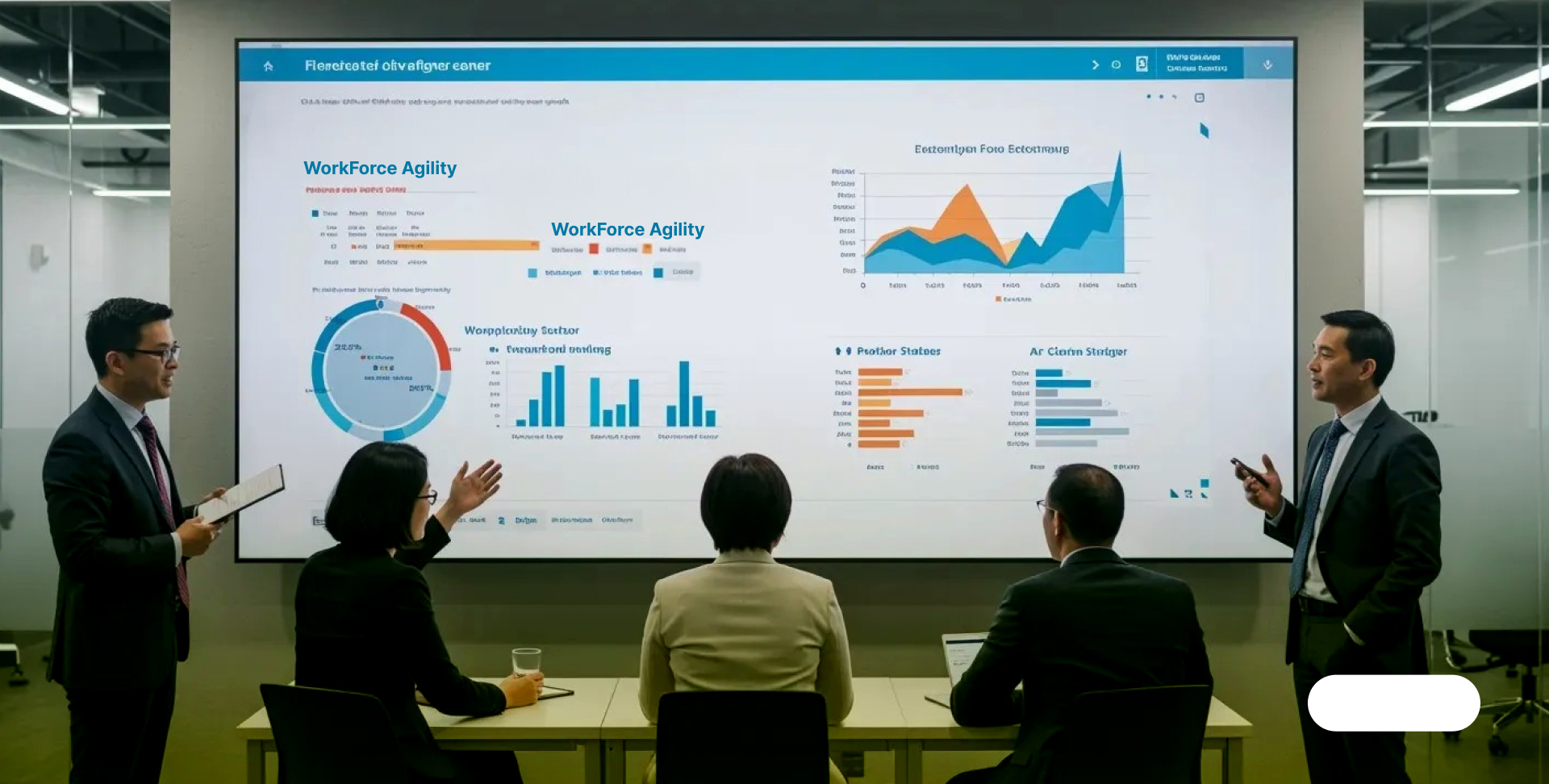
How do organizations actually make this shift? Here's a practical framework:
Before you can build agility, you need to understand where you're starting. Key questions include:
This isn't about judgment—it's about honest assessment. Every organization has areas of strength and areas of opportunity.
Based on your assessment, where are the biggest gaps between where you are and where you need to be? Common agility blockers include:
Trying to transform everything at once is a recipe for failure. Instead, identify one or two high-impact areas where you can pilot new approaches. Maybe it's launching a skills-based internal marketplace in one division. Or creating a cross-functional "agility team" to tackle a specific challenge. Or implementing a new approach to learning in one function.
The goal is to generate wins that demonstrate what's possible and build appetite for broader change.
As pilots prove successful, expand them. Document what you've learned—both what worked and what didn't. Create champions who can spread practices to other parts of the organization. Adjust your approaches based on different contexts and needs.
For agility to become sustainable, it needs to be built into core systems and processes:
---
Building workforce agility is challenging work. Here are some common mistakes to watch out for:
Confusing activity with agility. Just because there's a lot of movement doesn't mean an organization is agile. True agility is purposeful adaptation—changing in ways that create value.
Ignoring the human element. Change is hard. People need time to adjust, support to develop new skills, and reassurance that they have a place in the new reality. Organizations that forget this create resistance instead of readiness.
Overcorrecting toward chaos. Agility doesn't mean abandoning all structure. People still need clarity about direction, priorities, and expectations. The goal is flexible frameworks, not free-for-alls.
Underinvesting in managers. Middle managers often determine whether agility initiatives succeed or fail. They need development, support, and permission to lead differently.
Expecting instant results. Building workforce agility is a multi-year journey. Organizations that expect transformation overnight will likely give up before seeing results.
---
When organizations get this right, the results are significant. Research from McKinsey found that companies in the top quartile of organizational health—which includes agility—deliver three times the total return to shareholders compared to companies in the bottom quartile.
But the benefits go beyond financial performance:
Greater resilience. Agile organizations recover faster from setbacks and are better positioned to handle whatever comes next.
Better talent outcomes. When people can grow, contribute, and adapt, they're more engaged and more likely to stay. Internal mobility reduces the costs and disruptions of external hiring.
Faster innovation. When teams can form quickly around new opportunities, organizations can test ideas and get to market faster.
Enhanced well-being. Perhaps counterintuitively, agility can actually reduce stress. When people have more control over their work and more opportunities to grow, they feel more capable and confident.
---
The world isn't slowing down. If anything, the pace of change will only accelerate. Organizations that build workforce agility position themselves not just to survive disruption but to thrive through it.
This isn't about chasing the latest management fad or implementing a trendy new technology. It's about fundamentally rethinking how work gets organized, how people develop, and how organizations respond to change.
The good news? Agility is buildable. It's not something you either have or you don't—it's a capability that can be developed through intentional effort and sustained commitment.
The question isn't whether your organization needs to become more agile. The question is how quickly you'll start building that capability.
Because in a world where change is the only constant, the ability to adapt isn't just an advantage—it's the whole game.
---
The bottom line: Workforce agility is the organizational superpower of our era. It requires thinking differently about skills, learning, work design, technology, and leadership. But for organizations willing to make the investment, the payoff—in resilience, performance, and human flourishing—is substantial. The future belongs to the adaptable.