The era of the sad desk salad eaten in a gray cubicle is officially over. Here's how the smartest companies are reimagining workspaces to actually serve the humans who use them.
---
Remember when "going to work" meant trudging into a fluorescent-lit building, parking yourself at an assigned desk, and staring at beige walls for eight hours? Yeah, that version of office life is having its funeral—and honestly, we're not sending flowers.
Something fascinating is happening right now in workplaces across the country. After years of remote work proving we can do our jobs from anywhere, companies are finally asking a question they should have posed decades ago: What would make people genuinely want to come into an office?
The answer is sparking what workplace designers are calling an "office renaissance"—a complete reimagining of what shared workspaces can look like, feel like, and accomplish. And spoiler alert: it has nothing to do with ping pong tables or beer fridges.
---
Let's be honest about something: the traditional office wasn't designed for work. It was designed for surveillance.
The cubicle farm layout that dominated the 20th century emerged from a factory mindset—the idea that productivity could be measured by physical presence and monitored through line-of-sight management. Workers were treated like interchangeable parts in a machine, assigned to identical workstations regardless of what their actual jobs required.
Here's the uncomfortable truth: research from environmental psychology has consistently shown that these spaces actively worked against human performance. A landmark study from the University of Sydney found that lack of sound privacy was the biggest source of workplace dissatisfaction, affecting concentration, stress levels, and even physical health.
The open-plan offices that replaced cubicles in the 2000s and 2010s? They often made things worse. While they were marketed as collaboration boosters, research published in the Philosophical Transactions of the Royal Society found that face-to-face interactions actually decreased by about 70% when companies switched to open floor plans. People compensated for the lack of privacy by putting on headphones and sending more emails—the exact opposite of what the design intended.
Then came March 2020, and everything we thought we knew about workspaces got thrown out the window—literally.
---
When millions of knowledge workers suddenly began working from home, something unexpected happened: many of them thrived.
Surveys consistently showed that remote workers reported higher satisfaction, better work-life balance, and—contrary to what skeptics predicted—maintained or even improved their productivity. A two-year Stanford study of over 1,600 workers found that remote work increased productivity by 13%, reduced attrition by 50%, and saved companies significant money on real estate.
But the story isn't that simple.
Many workers also experienced isolation, struggled with collaboration, and found it harder to build relationships with colleagues. Junior employees often felt disconnected from mentorship opportunities. Creative brainstorming sessions on Zoom felt flat compared to the energy of in-person whiteboarding. The boundaries between work and home blurred in ways that sometimes led to burnout rather than balance.
The real lesson from this massive unplanned experiment? Neither fully remote nor traditional office work is optimal for most people. What workers actually want is choice—the ability to match their environment to their tasks, energy levels, and personal needs.
This insight is driving the hybrid workspace revolution.
---
The most successful hybrid office designs operate on a principle called activity-based working (ABW)—a framework that flips the traditional model on its head.
Instead of assigning people to fixed desks and expecting them to do every type of work in the same spot, ABW provides a variety of purpose-designed spaces that employees choose based on what they're actually doing at any given moment.
Think of it like this: You wouldn't use the same room in your home for everything. You sleep in your bedroom, cook in your kitchen, and relax in your living room. Each space is optimized for its purpose. Activity-based working applies this same logic to the office.
A typical ABW environment might include:
The key insight behind ABW is that knowledge work isn't monolithic. In any given week, you might need to write a detailed report (requiring silence and focus), brainstorm campaign ideas with colleagues (requiring energy and interaction), have a sensitive one-on-one conversation (requiring privacy), and catch up on emails (requiring only basic functionality).
Forcing all these activities into the same physical context doesn't just feel awkward—it actively degrades performance.
---
Walk into the most compelling new office spaces, and you'll notice something immediately: plants everywhere. Natural light flooding in through large windows. Wood and stone surfaces replacing plastic laminates. Water features creating ambient sound. Views of greenery, whether real or simulated.
This isn't just aesthetic preference. It's science.
Biophilic design—the practice of incorporating natural elements into built environments—has robust research backing its benefits. A report by the environmental consulting firm Terrapin Bright Green reviewed over 500 studies and found consistent evidence that biophilic elements reduce stress, improve cognitive function, enhance creativity, and accelerate healing.
Human beings evolved over hundreds of thousands of years in natural environments. Our nervous systems are literally wired to respond positively to nature. When we spend our days in sterile artificial environments, we're fighting against our own biology.
Some specific findings are remarkable:
Research from the University of Oregon found that workers with views of nature took an average of 57 hours less sick leave per year than those without. A study from Human Spaces found that employees in offices with natural elements reported 15% higher wellbeing scores. And research published in the Journal of Experimental Psychology demonstrated that simply having plants visible in a workspace improved memory retention and concentration.
The most thoughtful hybrid workspaces now treat biophilic design as fundamental infrastructure, not decoration. This means:
---
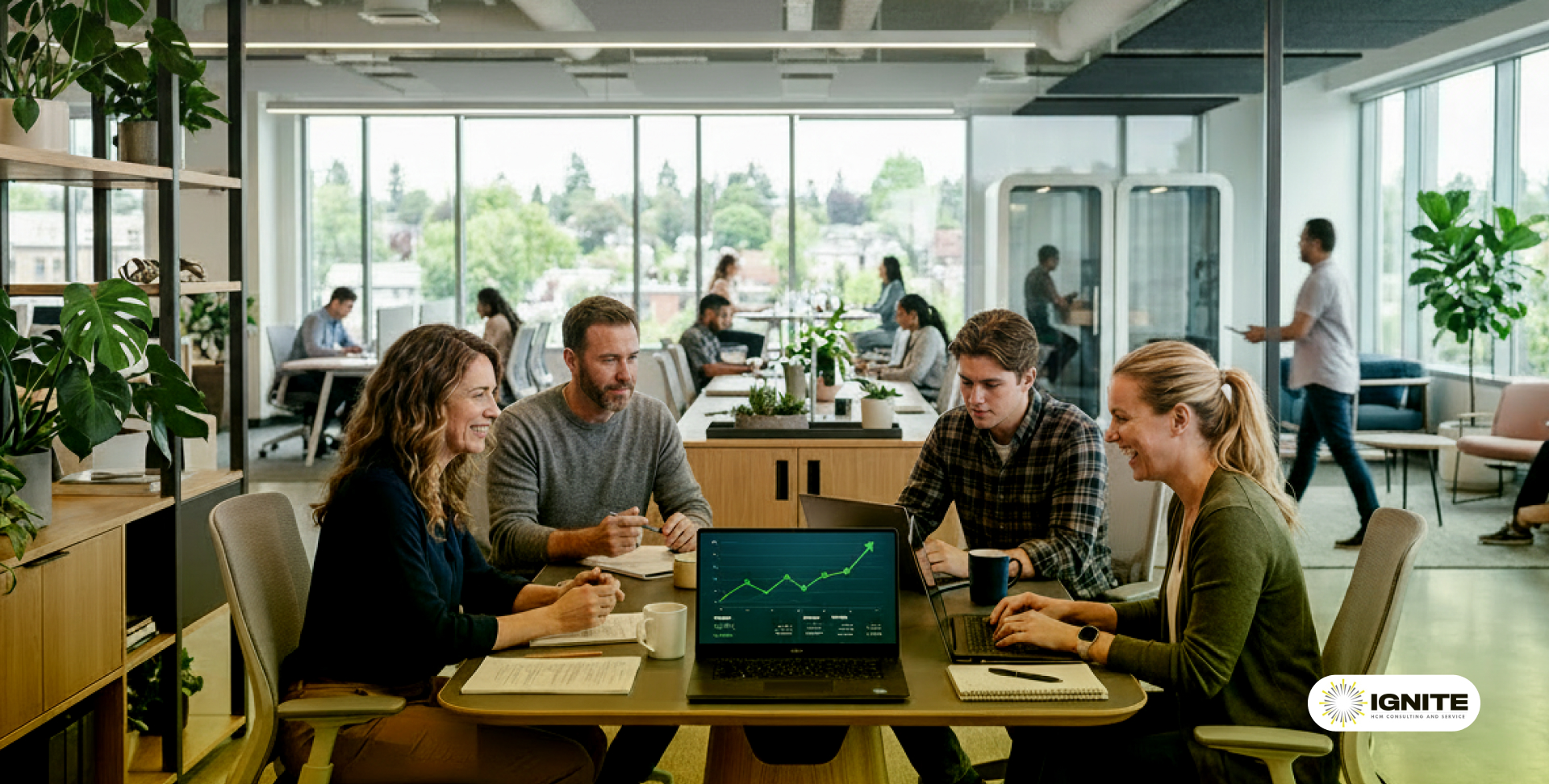
One of the trickiest challenges in hybrid design is balancing flexibility with belonging. If nobody has a permanent desk, how do people maintain connection to their teams? How do you avoid the "hotel lobby" feeling where everyone is just passing through?
Enter the neighborhood model.
Rather than assigning individual desks, many companies now assign teams to "neighborhoods"—zones within the office where their group is based. Within that neighborhood, seating is flexible, but the zone itself becomes home base.
This approach accomplishes several things at once:
It preserves the spontaneous interactions that make offices valuable. When you know your teammates are generally in a particular area, you're more likely to bump into them, have quick conversations, and maintain the social fabric that makes collaboration feel natural.
It allows teams to customize their environment. A creative team might want lots of writable walls and movable furniture. An engineering team might need more focus pods and individual workstations. A sales team might prioritize phone booths and video conferencing spaces. Neighborhoods can be designed around actual team needs.
It creates a sense of identity and ownership. Even without assigned desks, having a "home zone" gives people a place they belong. Teams can personalize their neighborhoods, creating the psychological ownership that research shows increases engagement and commitment.
---
Beautiful design means nothing if people show up and can't find a place to sit, can't locate their colleagues, or can't connect seamlessly to their virtual teammates.
Effective hybrid spaces require a robust technology infrastructure that includes:
Space booking systems that let people reserve desks, rooms, and resources before they arrive. The best systems provide real-time availability, suggest optimal choices based on who else is coming in, and learn from usage patterns to improve recommendations over time.
Wayfinding tools that help people navigate the space and find colleagues. This might include digital displays showing occupied and available areas, mobile apps with indoor mapping, and presence indicators that show which teammates are in the building.
Equitable video conferencing setups that ensure remote participants aren't second-class citizens in meetings. This means investing in quality cameras, microphones, and displays—and rethinking room layouts so in-person attendees are oriented toward the screen rather than each other.
Environmental sensors that monitor air quality, temperature, noise levels, and occupancy. This data helps facilities teams optimize conditions in real-time and informs longer-term design decisions.
The goal is making the hybrid experience feel effortless. When technology works invisibly, people can focus on their actual work instead of fighting with logistics.
---
Here's a mental model shift that's reshaping office design: rest isn't the opposite of productivity—it's a component of it.
Neuroscience research has thoroughly documented that the brain cannot maintain peak cognitive performance continuously. The prefrontal cortex—responsible for executive functions like planning, decision-making, and creative thinking—depletes its resources during demanding work and requires recovery time to restore them.
This means that offices designed purely for "productive" activities are actually undermining productivity.
The most forward-thinking hybrid spaces now include dedicated areas for restoration:
These aren't perks or luxuries. They're recognition of how human beings actually function—and they signal that companies value sustainable performance over performative busyness.
---
If you're wondering whether all this design innovation is just architects having fun with clients' money, the data suggests otherwise.
Multiple large-scale surveys have identified what draws people to the office voluntarily:
A Gensler workplace survey of thousands of workers found that access to focus spaces, collaboration with colleagues, and in-person access to leadership were the top reasons people wanted to come in. Notably, "my assigned desk" ranked very low—suggesting that what people want isn't their specific seat, but the experiences the office enables.
Research from Leesman, which has surveyed over a million workers, found that the workplaces scoring highest in effectiveness shared common traits: variety of spaces, excellent technology, abundant natural light, good acoustic management, and flexibility to work in different modes.
A Microsoft Work Trend Index report found that 73% of workers wanted flexible remote options to remain—but 67% also wanted more in-person time with their teams. People don't want to choose between remote and office; they want both, intelligently integrated.
The message is consistent: give people genuine choice, design spaces for specific purposes, invest in quality over quantity, and trust adults to manage their own work patterns.
---
As offices evolve, there's a critical conversation happening about who these new spaces serve—and who they might exclude.
Thoughtful hybrid design considers:
Accessibility beyond minimum compliance. This means considering neurodivergent workers who may need quiet spaces or specific lighting conditions, not just wheelchair accessibility.
Equity between remote and in-person workers. If the best opportunities, information, and relationships flow to those physically present, hybrid arrangements become two-tiered systems that disadvantage people who work remotely more often—often women, caregivers, and people with disabilities.
Cultural differences in space use and privacy expectations. What feels collaborative to one person may feel intrusive to another based on cultural background.
Economic accessibility. If commuting to the office requires expensive transportation, childcare, or professional clothing, flexibility needs to account for these barriers.
The most successful hybrid strategies address these equity dimensions explicitly rather than assuming that "flexibility" automatically means "fairness."
---
Whether you're a company leader rethinking your space, an employee advocating for better design, or just curious about evaluating workspaces, here's a simple framework:
The Four Cs of Hybrid Workspace Design:
Rate each dimension honestly. Where are the gaps? That's where investment will have the highest impact.
---
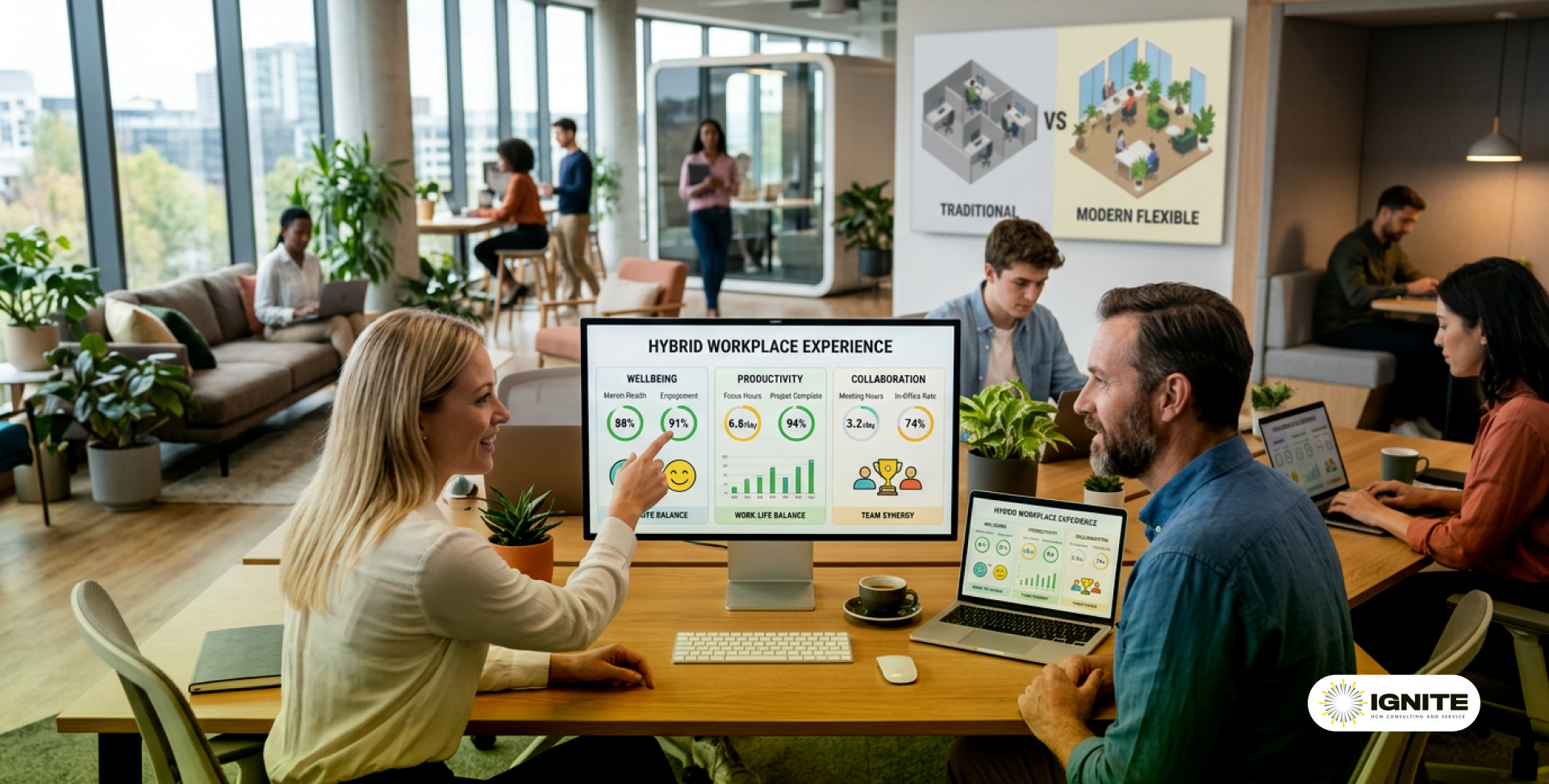
Here's the thought that should animate all of this: the physical environments we create reflect our values.
The old office—with its surveillance-oriented layouts, hierarchy expressed through corner offices, and standardized spaces treating all workers as interchangeable—reflected particular beliefs about work and workers. Beliefs that employees couldn't be trusted. That management required watching. That uniformity mattered more than effectiveness.
The emerging hybrid office represents a different set of values: that adults can manage their own time, that different tasks require different conditions, that wellbeing enables performance rather than detracting from it, that connection matters alongside productivity.
The office renaissance isn't really about furniture or floor plans. It's about finally designing workspaces around how human beings actually function—rather than how we wished they would function or how convenient it was to monitor them.
And if that sounds revolutionary, maybe it says more about how poorly we've designed workplaces for the past century than about how radical this new approach actually is.
---
We're still in the early chapters of this transformation. Many companies are experimenting, learning, adjusting. There's no single template that works everywhere—the right design depends on industry, culture, work patterns, and employee preferences.
But the direction is clear. The workspaces that attract and retain talent will be the ones that earn people's presence rather than demanding it. They'll offer experiences and capabilities that home offices can't match. They'll support the full range of human needs—cognitive, social, physical, emotional.
The beige cubicle isn't coming back. And good riddance.
What's emerging in its place has the potential to make work not just more effective, but more humane. And that's a renaissance worth participating in.