If you run payroll for one company, year-end is a project. If you run payroll for three EINs, year-end is three projects that share your calendar, your team, and your deadline. Nothing about having multiple legal entities makes any single task harder. What it does is multiply every task, and then add a category of problems that single-EIN companies never see: the ones that live in the seams between entities.
The math is blunt. Every EIN files its own W-2s, its own quarterly and annual returns, its own state unemployment accounts. The 2026 W-2s and 1099-NECs are due by February 1, 2027 (January 31 is a Sunday), and that deadline doesn't care whether you're issuing forms under one EIN or seven. Each entity has to tie out on its own, and then the places where entities touch — employees who transferred, benefits that span companies, shared ownership that affects tax rules — have to tie out too.
Most multi-EIN year-end disasters don't come from one entity being a mess. They come from a team that closed each entity competently but never looked at the seams. Here's where the real work is, and why starting now matters more for you than for anyone else.
Inside your organization, "the company" might feel like one thing. To the IRS, SSA, and every state agency, each EIN is a separate employer. Separate W-2 batches. Separate wage-and-tax reconciliations. Separate tax deposit histories to confirm. Separate state unemployment rates and accounts. If you have four EINs, your year-end checklist isn't one list with a few extra lines; it's four full lists.
This is also true for wage bases and limits in ways that surprise people every January. The Social Security wage base (officially $192,300 for 2027) generally applies per employer. So does unemployment wage tracking. The practical consequence: an employee who earned wages under two of your EINs this year may have had Social Security tax withheld past the annual cap when you look across both, and the rules for how that gets sorted differ depending on how your entities are related. You need to know who those people are before W-2s go out, not after.
Here's the seam that bites hardest: employees who moved between your EINs during 2026. A promotion into the parent company, a reorg that shifted a department into a subsidiary, an acquisition that moved staff onto your paper. Each of those employees now has wages under two employers, and that raises questions with real money attached.
Did the new entity restart Social Security and unemployment wage bases, and should it have? Depending on how the transfer was structured, there are rules that can let a successor employer carry prior wages forward, and applying them wrong in either direction costs someone money: the company overpays unemployment tax, or the employee overpays Social Security, or taxes are underpaid and penalties follow. Did 401(k) deferrals carry over correctly so the employee doesn't blow past the annual limit across two payrolls? Will the employee understand why they're getting two W-2s? Every transferred employee is a small reconciliation project, and they're invisible until someone pulls the list.
Multi-EIN organizations love shared benefit plans: one 401(k), one medical plan, one FSA arrangement covering everyone. Sensible for benefits. Tricky for payroll. The plan sees one population; payroll sees several. Deferral limits, matching formulas, and nondiscrimination testing all have to reconcile across entities, while the deductions funding them are processed separately in each EIN's payroll.
Year-end is when the mismatches surface. A deferral limit tracked correctly within each EIN but exceeded across them. A benefits deduction set up with slightly different tax treatment in one entity than its siblings. A recordkeeper file that's clean for three companies and quietly wrong for the fourth. If your entities are under common control, how they're treated for plan purposes is its own legal question, one more thing to confirm with your advisor rather than assume.
Four entities don't close well simultaneously with one team. The organizations that get through multi-EIN year-end calmly treat it as a sequenced program: a defined order, owners per entity, and the cross-entity reconciliations scheduled as their own workstream rather than squeezed in at the end.
There's judgment in the sequencing. Some teams close the cleanest, smallest entity first to shake out the process, then take the complex ones with lessons learned. Others start with the entity that has the most seam issues because those take longest to resolve. What doesn't work is deciding in late December. A few things belong on the schedule no matter what: a cross-entity list of every employee with wages under more than one EIN, a per-EIN wage-and-tax tie-out, and a confirmation that every entity's tax deposits match its liabilities. The full sequencing framework, with the complete task list per entity, is in the Ignite HCM Year-End Checklist (ignitehcm.com/yearend-guide).
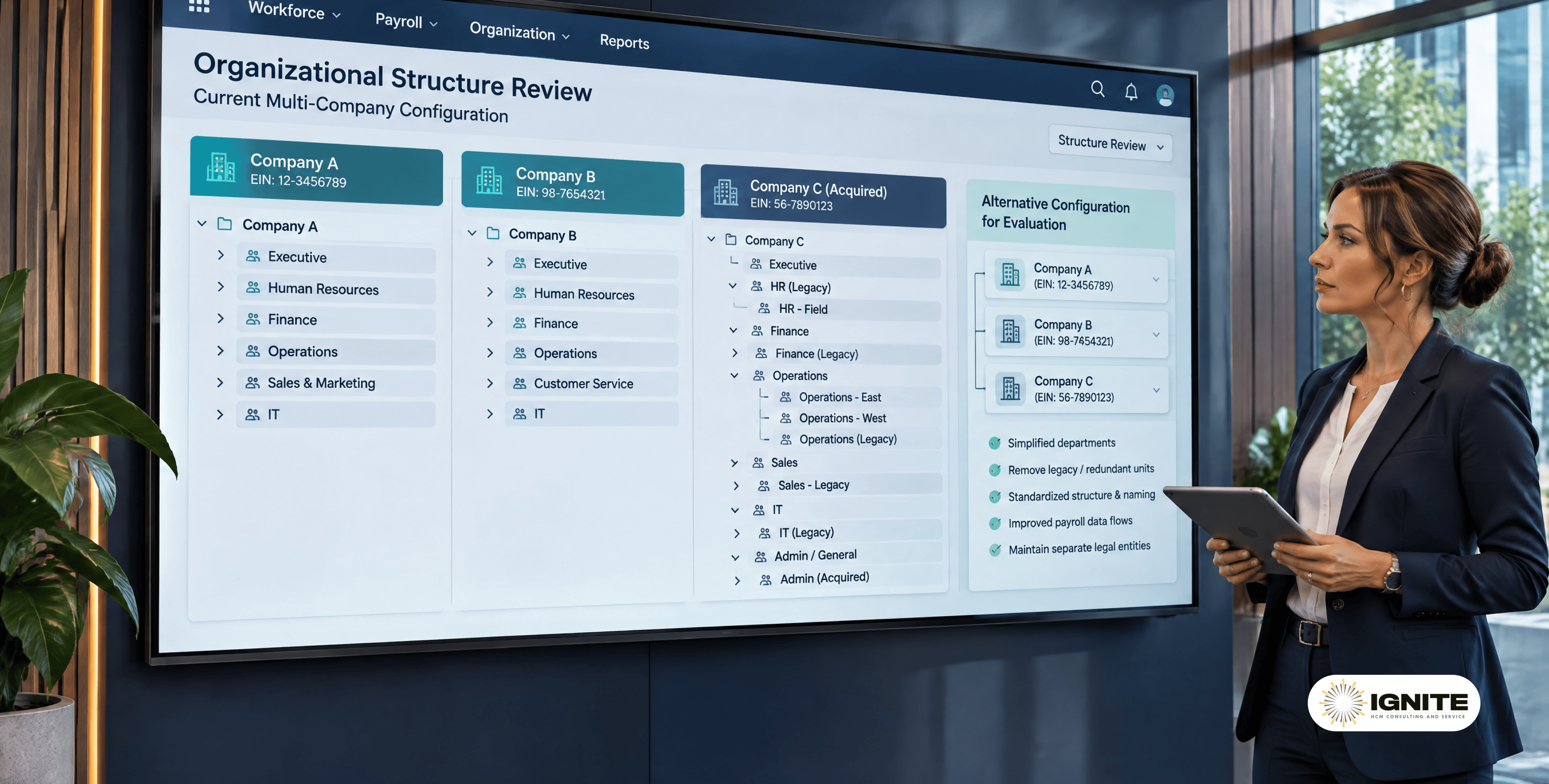
If this is the third year in a row that year-end has felt like whack-a-mole across entities, the problem may not be your process. It may be your structure. Some multi-EIN setups exist for solid legal and business reasons. Others are leftovers: an acquisition never consolidated, an old entity kept alive out of inertia, companies split for a reason nobody can state anymore.
A consolidation review looks at whether your ADP Workforce Now structure still matches your business. Sometimes the answer is to merge entities or restructure how they're set up in the platform; sometimes it's to keep the structure but fix how data flows between the pieces. Either way, January through March (right after the close, while the pain is fresh and before the new year piles up) is the best window to do that thinking. The worst time is November. Which is one more reason to get this year's close under control now.
One we see every year: a company with a few EINs transfers a group of employees from one entity to another in a spring reorganization. Payroll in the receiving entity starts everyone fresh: new wage bases, new deferral tracking. Nobody reconciles across entities until W-2 season. The damage: a batch of employees with excess Social Security withholding, several who exceeded their 401(k) limit across the two payrolls and needed corrective distributions, overpaid state unemployment tax the company has to chase back, and corrected forms across two EINs. The overpayments, corrections, and consulting fees run well into five figures, and the six-week cleanup that follows consumes the payroll team's entire first quarter. The transfers themselves were fine. The seam was never checked.
If no employees moved between entities and no benefits span them, you're in decent shape. If either is true, clean individual closes can still hide cross-entity errors. The seams don't show up on any single entity's reports; that's exactly what makes them dangerous.
Earlier than a single-EIN close, and November is the realistic line. You need time for per-entity tie-outs plus the cross-entity reconciliations, and the cross-entity issues are the slow ones because they usually require research, not just corrections.
Excess Social Security withholding for transferred employees, blown retirement limits, overpaid or underpaid unemployment tax, and corrected W-2s multiplied across entities. The per-form costs are the same as anyone's; you just have more forms and more ways to get them wrong.
Ignite HCM works with ADP exclusively, and our team is made up of former ADP service professionals who have closed more multi-EIN year-ends than we can count. You won't work a ticket queue. You'll work with a dedicated consultant who builds the sequence with you, runs the cross-entity reconciliations, and stays on it until every EIN is closed. Your people need to get paid. We make that happen.
Year-end is won in November, not January. Grab the free Ignite HCM Year-End Checklist or REQUEST A CONSULTATION and we'll run it with you.
ADP and the ADP logo are registered trademarks of ADP, Inc. This article is general guidance only, not tax or legal advice. Entity structure, successor-employer, and plan questions depend on your facts — confirm with your licensed advisor.