What if the biggest problems in your HR department were invisible—hiding in plain sight within your everyday workflows?
Here's a truth bomb that might surprise you: most HR teams are running on autopilot, repeating processes that haven't been examined in years (or even decades). They're spending countless hours on tasks that could take minutes, losing top talent to clunky hiring processes, and burning out their own team members without even realizing why.
Enter HR process mining—a game-changing approach that's like getting an X-ray of your entire human resources operation. It reveals exactly where things are slowing down, where bottlenecks are forming, and where your well-intentioned processes are actually working against you.
And the best part? Once you see these hidden patterns, you can't unsee them. Suddenly, the path to a smoother, more human-centered workplace becomes crystal clear.
---
Let's break this down into simple terms.
Process mining is a technology that looks at the digital footprints left behind by every action in your HR systems. Every time someone submits a job application, requests time off, completes a performance review, or goes through onboarding, data is created. Process mining takes all that data and turns it into a visual map of how work actually flows through your organization.
The key word here is "actually."
See, there's often a huge gap between how we think processes work and how they really work. Your employee handbook might say onboarding takes two weeks. Your process mining data might reveal it actually takes six weeks—with new hires waiting an average of ten days just to get their laptop set up.
That's the kind of insight that changes everything.
Think of it like this: if your HR department were a house, process mining would be like using thermal imaging to find where all the heat is escaping. You might think your house is perfectly insulated, but the data tells a different story—and shows you exactly where to focus your repair efforts.
---
To understand how this works, let's explore the four main components that make HR process mining so powerful.
Every HR system you use—from your applicant tracking software to your payroll platform to your learning management system—generates event logs. These logs record what happened, when it happened, and who was involved.
Process mining tools pull this data together from multiple sources, creating a comprehensive picture of your HR ecosystem. This isn't about surveillance or micromanaging employees. It's about understanding system behavior, not individual performance.
Once the data is collected, process mining algorithms create visual flowcharts of how work actually moves through your organization. These maps often reveal surprising detours, loops, and dead ends that nobody knew existed.
For example, you might discover that:
After mapping the actual process, you can compare it to how the process is supposed to work. This gap analysis highlights where reality diverges from intention—and where compliance risks might be lurking.
Finally, process mining provides data-driven recommendations for improvement. Instead of guessing what might help, you have concrete evidence pointing toward specific solutions.
---
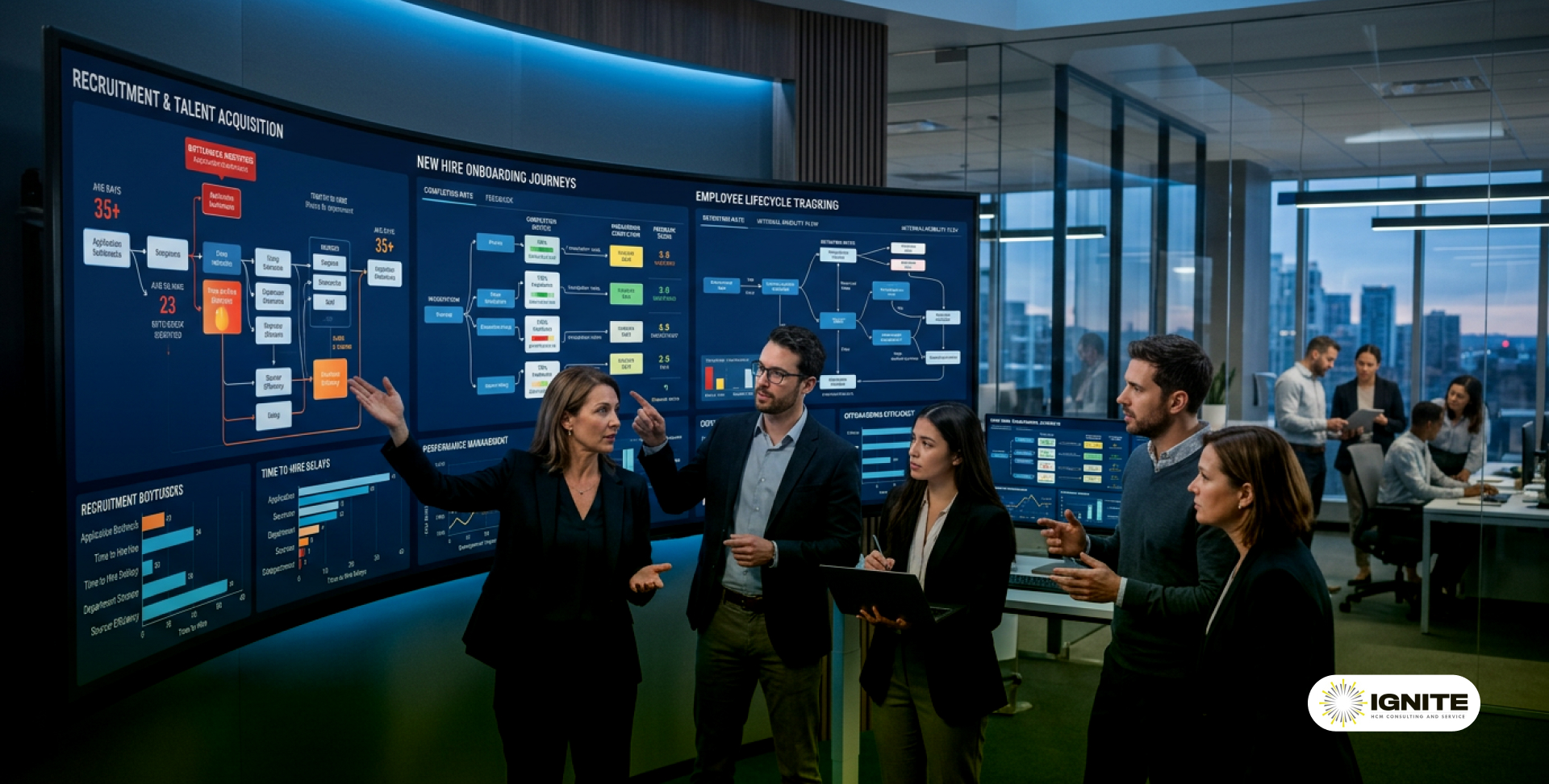
Not all processes benefit equally from this deep analysis. Here are the areas where HR process mining typically delivers the most dramatic results.
The hiring process is often where process mining reveals its most jaw-dropping insights.
Consider this scenario: A company believes their average time-to-hire is 30 days. Process mining reveals it's actually 52 days—and the biggest delay happens during the interview scheduling phase, where candidates wait an average of 11 days between each interview round.
By the time offers go out, the best candidates have already accepted positions elsewhere.
Common bottlenecks process mining uncovers in recruiting:
One study by SHRM found that the average cost-per-hire is over $4,700. When inefficient processes cause you to lose your top choice and settle for your second or third pick, that cost multiplies in ways that don't show up on any spreadsheet.
New employee onboarding is another goldmine for process mining insights.
Research consistently shows that effective onboarding significantly improves retention and time-to-productivity. Yet many organizations treat onboarding as a checklist of disconnected tasks rather than a cohesive experience.
Process mining might reveal that:
The framework to consider here is the "Moments That Matter" approach. Not every step in onboarding carries equal weight. Process mining helps identify which touchpoints have the biggest impact on new hire success—so you can prioritize improving those first.
If your performance review process feels like pulling teeth, you're not alone.
Process mining can show you exactly why. Maybe reviews consistently get submitted at the last minute because the approval workflow is too complicated. Perhaps certain managers skip calibration meetings entirely. Or the system might reveal that feedback from performance reviews never actually connects to development planning.
When you can see these patterns, you can address the root causes—not just the symptoms.
Here's something most organizations overlook: the offboarding process matters just as much as onboarding.
Process mining often reveals alarming gaps in offboarding:
These gaps create security risks, compliance issues, and missed opportunities to learn from departing employees.
---

Beyond the technology itself, HR process mining represents a fundamental shift in how we think about HR operations. Let's call it the Process Mining Mindset—and it's built on three key principles.
Traditional HR metrics often focus on what's simple to track: headcount, turnover rate, time-to-fill. These numbers tell you what happened but not why or how.
Process mining encourages measuring the journey, not just the destination. Instead of just tracking that a position was filled in 45 days, you understand exactly how those 45 days were spent—and where time could be reclaimed.
Every organization has processes that exist simply because they've always existed. Nobody remembers why that extra approval step was added, but removing it feels risky.
Process mining provides the evidence needed to challenge these sacred cows. When data shows that a particular step adds no value and delays outcomes by an average of four days, suddenly change becomes much easier to justify.
Individual tasks can be perfectly efficient while the overall process remains broken. Process mining shifts attention from optimizing individual activities to optimizing the end-to-end experience.
It's the difference between having the fastest runners and actually winning the relay race.
---
If you're intrigued by HR process mining, here's a step-by-step approach to getting started.
Before diving into data, identify which processes cause the most frustration—for HR, for managers, and for employees. Common candidates include:
Process mining requires event log data with timestamps. Take inventory of your HR systems and evaluate:
Many organizations discover they're data-rich but insight-poor. They have plenty of information but no way to connect the dots.
Rather than trying to mine every HR process at once, pick one high-impact area for a pilot project. This allows your team to learn the methodology, build confidence, and demonstrate value before scaling up.
Process mining insights are only valuable if they lead to action. Make sure you have buy-in from:
This might seem obvious, but it's where many process mining initiatives stall. Analysis without action is just expensive curiosity. Create clear accountability for implementing improvements—and then measure whether those improvements actually worked.
---
Here's something important to remember: HR process mining isn't about turning your workplace into a machine. It's actually about creating more space for the human in human resources.
When you eliminate unnecessary waiting, redundant approvals, and confusing workflows, you create room for:
Technology handles the mechanics so humans can focus on connection.
Think about it this way: every hour your HR team spends chasing down a lost approval or reconciling data between systems is an hour they can't spend on strategic work, employee wellbeing, or building culture.
Process mining helps you reclaim those hours.
---
As with any powerful tool, HR process mining comes with potential pitfalls. Here are the most common mistakes and how to avoid them.
The data can be fascinating—almost too fascinating. Teams sometimes get so absorbed in analyzing that they never move to improving. Set clear timelines and decision points to keep momentum going.
Processes involve people, and people have reasons for the workarounds and shortcuts they create. Before "fixing" something, understand why it exists. That manual step you want to eliminate might be catching errors that the system misses.
Speed isn't always the right metric. A hiring process that moves candidates through faster isn't better if it results in worse hiring decisions. Make sure you're measuring what actually matters for outcomes.
Process efficiency and employee experience sometimes conflict. A fully automated process might be faster but feel cold and impersonal. Always consider the human experience alongside the operational metrics.
---
Looking ahead, HR process mining is evolving in exciting directions.
Predictive capabilities allow organizations to forecast process bottlenecks before they occur. Imagine knowing that your recruiting process will hit a wall in three months and having time to address it proactively.
Integration with AI enables more sophisticated pattern recognition and recommendation engines. Instead of just showing you what's broken, future tools will suggest specific solutions based on what's worked at similar organizations.
Real-time monitoring moves process mining from a periodic analysis exercise to continuous operational intelligence. Like a fitness tracker for your HR processes, you'll see performance metrics updating constantly.
---
HR process mining isn't just another technology trend—it's a fundamental capability for organizations that want to operate smarter and create better employee experiences.
The most successful HR teams of the future won't be the ones with the biggest budgets or the most people. They'll be the ones who truly understand how work flows through their organization—and continuously improve based on evidence rather than assumptions.
Because when you can see clearly, you can act decisively.
The processes running your HR department right now have stories to tell. Stories about where time is being wasted, where employees are getting frustrated, and where small changes could make massive differences.
The only question is: are you ready to listen?
Your next step: Pick one HR process that's been bothering you. Map out how you think it works. Then talk to the people who actually use it every day. The gap between those two versions is exactly where process mining starts—and where your opportunity for transformation lives.