
For years, compensation benchmarking has been a time-consuming and often inaccurate process for HR teams. Relying on static, quickly outdated salary surveys and limited data points made it difficult to gain a true picture of the competitive landscape and ensure your organization was paying employees fairly.
Enter artificial intelligence. AI-driven compensation benchmarking is transforming how companies analyze pay data, providing dynamic, real-time insights to make smarter, fairer compensation decisions. By leveraging vast datasets, machine learning algorithms, and predictive analytics, AI benchmarking tools deliver unprecedented accuracy, efficiency and strategic value.
Here's how AI is ushering in a new era of compensation benchmarking—and why your organization can't afford to ignore this game-changing technology.
To understand AI's revolutionary potential, it's important to recognize the shortcomings of traditional compensation benchmarking:
Infrequent updates: Most salary surveys are only conducted annually or even less frequently. In today's fast-moving market, these static snapshots quickly become outdated. AI enables dynamic benchmarking with continuous updates.
Small sample sizes: Surveys often have limited sample sizes that may not be representative of the full market, especially for niche roles. AI can analyze massive datasets for more accurate insights.
Lack of granularity: Broad job categories and titles in surveys don't account for the nuances of specific roles and skills. AI enables precise matching based on detailed job descriptions and requirements.
Manual effort: Participating in surveys, aggregating data and generating reports is tedious and time-consuming. AI automates data collection and analysis for huge efficiency gains.
Reactive approach: The lag time of traditional benchmarking leads to a reactive approach to compensation. AI empowers organizations to proactively track market shifts and adapt in real-time.
Simply put, traditional benchmarking can't keep pace with today's fast-moving talent market. It's time for an upgrade—and AI is the answer.
AI brings powerful capabilities to compensation benchmarking that simply weren't possible before. Here are some of the key advantages:
Dynamic, real-time data: AI benchmarking tools continuously scrape data from a variety of sources, including job postings, company websites, employee reviews and more. This enables up-to-the-minute tracking of market pay rates for the most current, accurate insights.
Massive, diverse datasets: By analyzing data from thousands of companies and job postings, AI provides a comprehensive view of the market based on huge sample sizes. Aggregating and anonymizing this data protects confidentiality while still yielding rich insights.
Granular job matching: Using natural language processing and machine learning, AI can analyze the nuances of job postings and descriptions to precisely match roles across companies and industries. This granular benchmarking ensures you're comparing apples to apples.
Predictive analytics: AI's predictive capabilities enable forward-looking insights to help you anticipate market shifts and proactively adapt your compensation strategy. By analyzing historical trends and economic indicators, AI models can forecast pay rate trajectories.
Scenario modeling: AI benchmarking tools allow you to model different scenarios, such as adjusting pay based on geographic location, industry, company size, skills and more. This enables a tailored approach to compensation to remain competitive for your specific talent needs.
Instant reporting: With AI, generating in-depth compensation reports takes minutes rather than weeks. Visual dashboards and natural language summaries make data easy to understand and act on. Reports can be instantly generated for different departments, locations and job families.
Integration with other HR systems: AI benchmarking tools can integrate with your HRIS, applicant tracking system, payroll and other core HR technologies. This enables seamless data sharing for end-to-end compensation management.
With these advanced capabilities, AI empowers organizations to take a proactive, strategic approach to compensation management. Real-time, granular data provides the insights needed to adapt pay rates based on the most current market realities. Predictive analytics enable forward-looking adjustments to stay ahead of the curve. And instant reporting and integration streamline the compensation review process for maximum efficiency.
In short, AI makes compensation benchmarking faster, easier and smarter. Let's look at some of the key benefits and use cases.
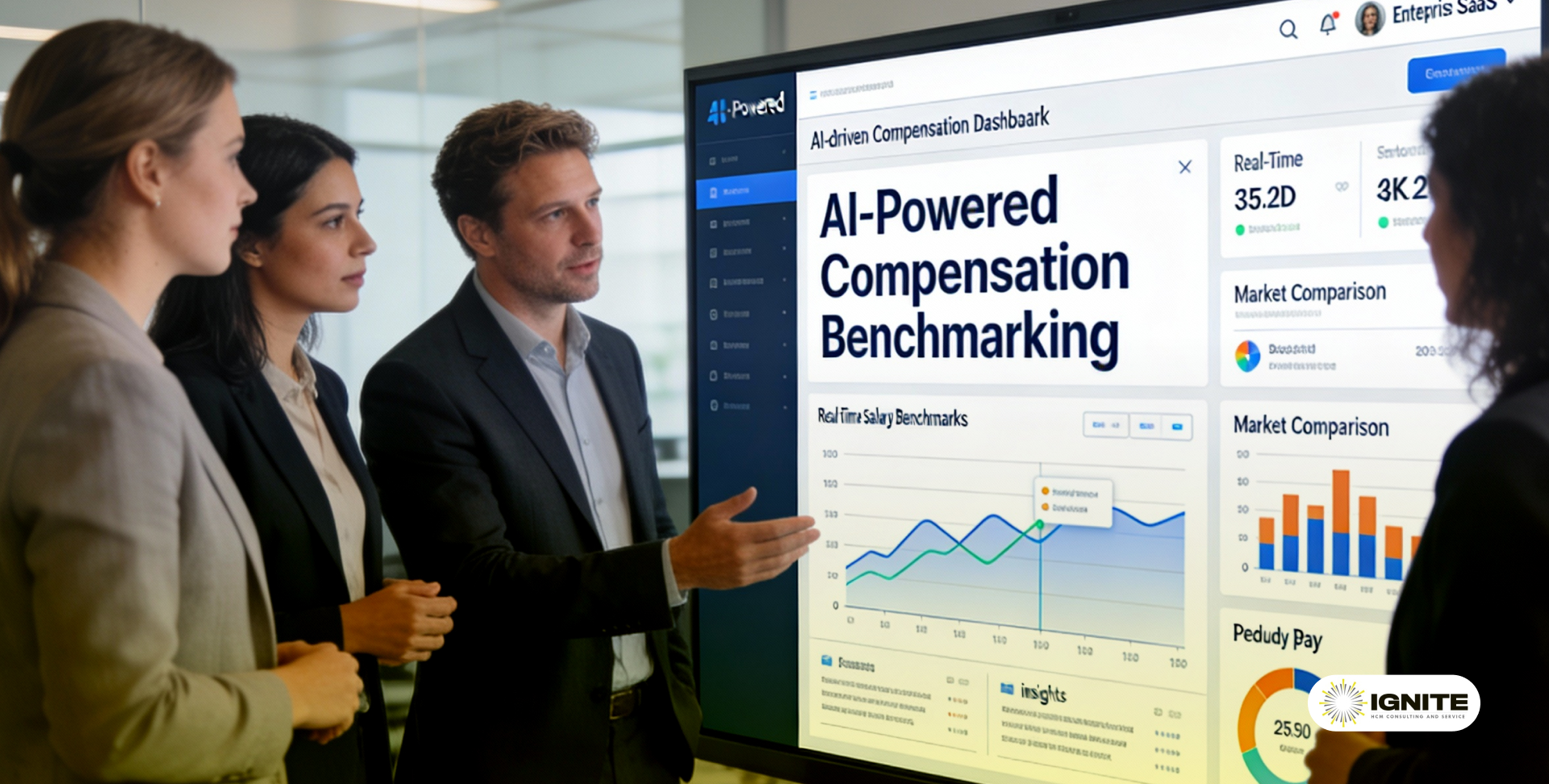
Adopting AI-driven compensation benchmarking delivers significant benefits for HR teams and the organization as a whole:
Improved accuracy and fairness: With comprehensive, real-time market data, AI helps ensure pay rates are truly competitive and equitable. This promotes fairness and objectivity in compensation decisions.
Faster time-to-hire: Access to instant market pay data helps speed up the offer process for new hires. No more waiting for survey data or manual research. AI empowers managers to make competitive offers on the spot.
Better employee retention: By proactively monitoring market pay rates, AI helps you ensure existing employees are paid fairly and competitively. This boosts retention by preventing top talent from being lured away by better offers.
Cost savings: While AI benchmarking tools require an upfront investment, the efficiency gains and turnover reduction often lead to significant cost savings in the long run. AI frees up HR teams to focus on higher-value priorities.
Stronger employer brand: Consistently offering competitive, fair compensation enhances your reputation as an employer of choice. In a tight labor market, that employer brand advantage can make all the difference in recruiting top talent.
So what are some common use cases for AI-driven benchmarking? Here are a few examples:
Annual compensation review: AI provides the most up-to-date market data to inform pay adjustments across the organization during annual review cycles. Predictive insights help factor in projected market shifts.
New hire offers: Managers can access real-time benchmarking data to make competitive offers to candidates, tailored to the specific requirements of the role. This streamlines the offer process and prevents losing top talent to competing offers.
Reclassifying roles: When a job description substantially changes, AI can instantly benchmark the new requirements against market data to determine if a pay adjustment is needed.
Geographic pay strategies: For organizations with distributed workforces, AI enables easy comparison of pay rates across different markets to inform geo-based compensation strategies.
Merger and acquisition activity: During M&A, AI streamlines the complex process of harmonizing compensation across two organizations by providing a common benchmarking framework.
Budgeting and workforce planning: AI-driven market insights inform budget allocation for compensation and help optimize headcount planning based on hiring needs and pay rate forecasts.
As these examples illustrate, AI-driven benchmarking brings efficiency and precision to virtually every aspect of compensation management. And with compensation being one of the biggest line items in most budgets, the return on investment can be substantial.
With the clear advantages of AI-driven compensation benchmarking, the key question becomes: How do you choose the right tool for your organization? Here are some important factors to consider:
Data sources: Look for a tool that pulls from a wide variety of reputable data sources for the most comprehensive, reliable insights. Find out how often data is refreshed.
Ethical AI: With the growing concern over AI bias, it's important to choose a vendor committed to developing ethical, unbiased algorithms. Ask about their approach to data privacy as well.
Customization: Your benchmarking tool should allow you to tailor data cuts and reports to your organization's specific needs. Beware of rigid, one-size-fits-all solutions.
Ease of use: The best AI tools bring powerful insights without overwhelming complexity. Look for intuitive dashboards, clear data visualizations and seamless integration with your existing HR tech stack.
Predictive capabilities: To gain a true competitive advantage, your AI benchmarking tool needs robust predictive analytics for forward-looking insights. Ask vendors for examples of how their tool forecasts pay trends.
Implementation and support: Transitioning to an AI-powered compensation management process takes change management. Look for a vendor with a strong customer success track record and comprehensive implementation support.
By carefully evaluating AI benchmarking solutions against these criteria, you can find the right tool to revolutionize your compensation strategy and provide a competitive edge in the race for talent.
As powerful as today's AI-driven compensation tools are, we've only scratched the surface of this technology's potential. As AI continues to advance, we can expect even more sophisticated benchmarking capabilities, such as:
Hyper-personalization: AI will enable benchmarking not just at the job level, but at the individual level, factoring in an employee's unique skills, experience, performance and potential to recommend truly personalized pay.
Real-time pay optimization: Imagine AI that dynamically adjusts an employee's pay rate in real-time based on market conditions, skill acquisition, role changes and more. Compensation management will shift from a periodic activity to a continuous, automated process.
Predictive attrition modeling: By analyzing pay data alongside other HR metrics like engagement scores and performance ratings, AI models will predict which employees are at risk of leaving due to compensation factors and recommend proactive adjustments.
Augmented pay negotiations: AI-powered chatbots will negotiate starting salaries with candidates, using real-time market data to find the right balance between competitive pay and budget constraints.
Compensation equity audits: AI tools will continuously monitor pay equity across the organization, flagging potential disparities based on gender, race, age and other protected characteristics for proactive remediation.
While some of these scenarios may seem like science fiction, they're fast becoming reality as AI technology accelerates. Forward-thinking HR leaders will keep a close eye on these trends and start laying the foundation for more advanced AI applications in their compensation function.

As the war for talent intensifies, organizations can't afford to rely on outdated compensation benchmarking methods. AI-driven benchmarking is quickly becoming table stakes for employers looking to attract and retain the best people.
But adopting AI isn't just about plugging in a new software solution. It requires a fundamental shift in mindset and strategy around compensation management. HR leaders must become comfortable with a more data-driven, dynamic and transparent approach to pay.
Change can be daunting, but the rewards are well worth the effort. By harnessing the power of AI for compensation benchmarking, organizations can gain a true competitive edge in the battle for top talent. It's not just about paying more, but about paying smarter—and that's what AI enables.
If you haven't already, now is the time to start exploring AI-driven compensation benchmarking solutions. Partner with a reputable vendor, start small with a pilot program and build an internal change management plan to get key stakeholders on board.
Most importantly, don't wait for your competitors to outpace you. Getting started with AI now sets you up to capitalize on more advanced capabilities as they emerge. Your future talent—and your bottom line—will thank you.
The AI revolution in compensation management is here—and it's transforming the way we think about pay. Will you be at the forefront or left behind? The choice is yours. But one thing is clear: AI-driven benchmarking is the future of compensation strategy. Embrace it, and reap the rewards for your people and your business.
Ready to revolutionize your compensation strategy? Discover how AI-driven benchmarking can help you make smarter, fairer pay decisions and win the war for talent.