Why the one-size-fits-all approach to workplace support is officially over—and what smart companies are doing instead
---
Here's a truth bomb that might seem obvious once you hear it: the way your 25-year-old hybrid marketing coordinator experiences work is radically different from how your 52-year-old on-site operations manager does. Their stressors are different. Their motivations are different. Their needs from HR? Completely different.
Yet for decades, Human Resources departments have operated like a doctor who prescribes the same medication to every patient, regardless of symptoms. Open enrollment looks the same for everyone. Training programs follow identical formats. Communication goes out in one style, through one channel, expecting the same response from wildly different people.
It's not working anymore. And forward-thinking organizations have caught on.
Welcome to the era of employee personas—a concept borrowed from marketing that's revolutionizing how companies support their workforce. Think of it as the workplace equivalent of personalized wellness: meeting people where they are, not where you assume they should be.
---
An employee persona is a research-based profile that represents a specific segment of your workforce. It goes beyond job title or department to capture the whole human showing up to work each day—their life stage, communication preferences, career aspirations, pain points, and what actually motivates them to bring their best.
"Employee personas help HR teams stop guessing and start understanding," explains organizational psychologist Dr. Adam Grant in his research on workplace dynamics. Rather than designing programs based on assumptions, personas ground decisions in actual employee data and insights.
Here's what makes personas different from traditional demographics:
| Traditional Approach | Persona Approach |
|---------------------|------------------|
| Age: 35 | Life stage: Balancing caregiving responsibilities |
| Department: Sales | Work style: Results-driven, needs autonomy |
| Tenure: 5 years | Engagement driver: Recognition and growth opportunities |
| Location: Remote | Communication preference: Quick video messages over long emails |
See the difference? One gives you surface-level facts. The other gives you actionable understanding.
---
This isn't just a feel-good HR trend. The psychology backing personalized employee experiences is solid.
Self-Determination Theory, developed by researchers Edward Deci and Richard Ryan, identifies three core psychological needs that drive human motivation: autonomy (feeling in control of your choices), competence (feeling capable and effective), and relatedness (feeling connected to others). When workplace experiences honor these needs in the specific ways that matter to each person, engagement skyrockets.
A 2023 Gallup study found that employees who feel their unique contributions are recognized are 3.6 times more likely to be engaged at work. Meanwhile, Deloitte's research shows organizations with personalized employee experiences see 30% higher employee satisfaction and significantly lower turnover.
The bottom line? When people feel seen as individuals rather than headcount, they perform better, stay longer, and advocate for their workplace. It's the same principle that makes personalized medicine more effective than generic treatment—because humans aren't generic.
---

While every company's workforce is unique, certain patterns emerge across industries. Here are five common personas that serve as a starting point for understanding diverse worker needs.
Who they are: Typically in their 20s to early 30s, these employees are building skills, exploring career paths, and establishing professional identities. They may be paying off student loans, living with roommates, and figuring out what they actually want from work.
What drives them:
HR implications: This persona often gets overlooked in benefits conversations because traditional perks like retirement planning feel distant. But they're hungry for mentorship programs, skill-building workshops, and mental health support. They prefer bite-sized digital communication and want to understand the "why" behind company decisions.
Key insight: Early-Career Explorers aren't job-hopping because they're disloyal—they're searching for environments that invest in their growth. Companies that provide clear development trajectories keep them.
---
Who they are: Employees juggling significant caregiving responsibilities—whether for children, aging parents, or both (the "sandwich generation"). They're often in their 30s to 50s and may be high performers stretched thin by competing demands.
What drives them:
HR implications: This persona needs dependent care benefits, flexible scheduling options, and managers trained in accommodating life demands without penalizing careers. Long, mandatory meetings during school pickup hours? That's a silent signal that this company doesn't understand their reality.
Key insight: The Balancing Act persona often includes your most experienced employees. Losing them to inflexibility means losing institutional knowledge that took years to build. Accommodating their needs isn't charity—it's strategic retention.
---
Who they are: Employees approaching the final chapters of their working lives, typically in their 50s and 60s. They bring deep expertise, institutional memory, and perspective that only comes with decades of experience.
What drives them:
HR implications: This persona is often thinking about retirement but not ready to disappear overnight. Phased retirement programs, knowledge transfer initiatives, and mentor matching serve them well. They may prefer traditional communication channels and face-to-face conversations over constant digital pings.
Key insight: Companies that treat late-career employees as "on their way out" miss the opportunity to capture invaluable knowledge and maintain relationships that could extend into consulting or advisory roles.
---
Who they are: Employees who work primarily or entirely outside traditional office settings. This could include fully remote workers, hybrid employees, field workers, or traveling sales teams. They may have chosen remote work intentionally or adapted during the pandemic.
What drives them:
HR implications: Remote Warriors need digital-first HR services, asynchronous communication options, and intentional efforts to prevent isolation. They may feel invisible during promotion discussions or miss informal development opportunities that happen naturally in offices.
Key insight: "Out of sight, out of mind" is a real risk for this persona. Companies that create equitable experiences regardless of location build fierce loyalty among remote workers who feel genuinely included.
---
Who they are: Employees who can't work from home—healthcare workers, retail associates, manufacturing teams, hospitality staff. They often work non-traditional hours and may have limited access to email or company intranets during shifts.
What drives them:
HR implications: This persona needs mobile-friendly HR tools, communication through text or apps rather than email, and benefits that acknowledge physical demands. Town halls at 2 PM don't work for someone working the night shift.
Key insight: The pandemic revealed how essential these workers truly are. Organizations that continue treating them as afterthoughts in employee experience will struggle to hire and retain the people who literally keep operations running.
---
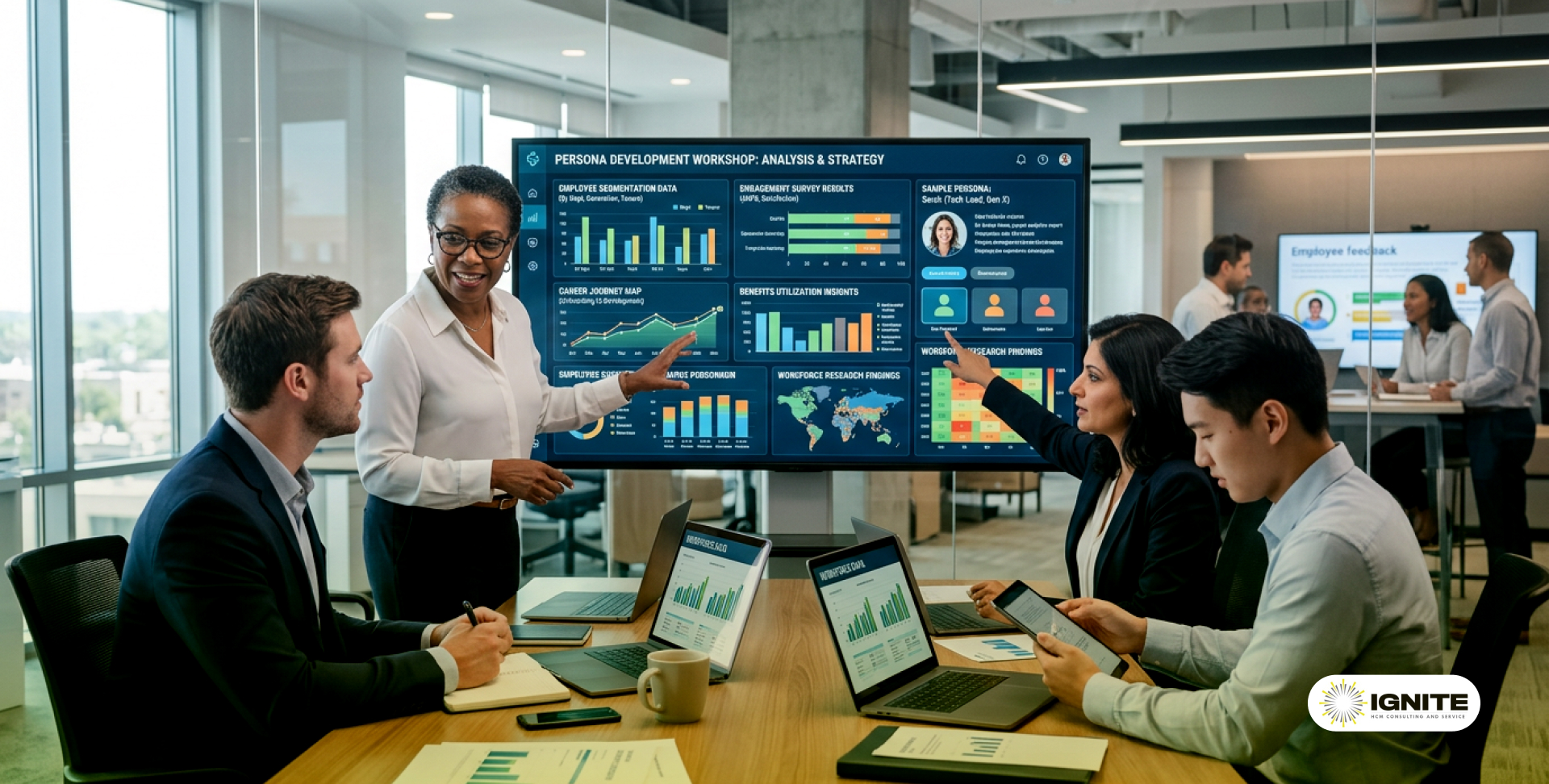
Creating useful personas requires more than assumptions and stereotypes. Here's a framework for developing authentic, actionable profiles.
Start with what you already have:
Then go deeper with qualitative research:
Look for clusters based on:
Pro tip: Avoid the trap of creating too many personas. Three to seven distinct profiles typically provide enough nuance without becoming unmanageable.
Give each persona:
This humanizes data and makes personas memorable for teams across the organization.
Test your personas against reality:
---
Understanding personas is one thing. Using them to transform HR services is another.
Instead of offering identical packages, consider:
Match channels and style to preferences:
Design growth opportunities that fit:
Acknowledge contributions in meaningful ways:
---
Personas should illuminate patterns while respecting individual variation. A 55-year-old could be an Early-Career Explorer starting a second career. A 28-year-old could be a primary caregiver. Use personas as starting points for understanding, not boxes that limit people.
Workforces evolve. What mattered to employees in 2019 shifted dramatically by 2024. Build regular persona review cycles—annually at minimum, or whenever significant changes affect your workforce.
Personas should inform decisions across the organization—from facilities planning to technology choices to management training. Share them broadly and train leaders to apply persona thinking in daily decisions.
Most employees don't fit neatly into one persona. A remote worker might also be a caregiver in their late career. Design systems flexible enough to accommodate complexity.
---
Let's be honest—personalizing HR services requires investment. More research. More program options. More nuanced communication. Is it worth it?
The data says yes. Organizations with highly personalized employee experiences report:
In an era where talent competition is fierce and employee expectations have permanently shifted, treating everyone identically isn't just ineffective—it's a competitive disadvantage.
---
You don't need to overhaul everything overnight. Begin here:
Week 1: Audit your current HR communications. Who are you actually designing for? Whose needs are you missing?
Week 2: Conduct three to five employee interviews across different roles and life stages. Ask: "What would make your experience here better?"
Month 1: Draft two to three initial personas based on patterns you observe.
Month 2: Test one program or communication change designed for a specific persona. Measure the response.
Quarter 1: Build the case for broader persona implementation based on early results.
---
The companies thriving in today's environment understand something fundamental: employees aren't resources to be managed uniformly—they're humans to be understood individually.
Employee personas offer a practical framework for scaling that understanding. They help HR teams ask better questions, design more relevant programs, and communicate in ways that actually land.
This isn't about creating more work for Human Resources departments already stretched thin. It's about making HR work smarter—investing energy where it has the greatest impact for specific groups rather than spreading efforts thin across generic programs nobody loves.
Because here's the ultimate truth: when employees feel understood, everything else becomes easier. Engagement rises. Retention improves. Performance lifts. Culture strengthens.
The era of one-size-fits-all HR is ending. The question isn't whether personalization will become standard practice—it's whether your organization will lead the shift or scramble to catch up.
Your workforce is already made up of distinct individuals with unique needs. Isn't it time your HR approach reflected that reality?