The office as we knew it has fundamentally shifted—and so has our understanding of what workplace connection actually means.
Here's something that might surprise you: According to Gallup's 2023 State of the Global Workplace report, having a best friend at work is one of the strongest predictors of employee engagement, productivity, and retention. Yet in our current hybrid landscape, forming those meaningful connections has become significantly more challenging.
We're navigating uncharted territory. The pandemic didn't just change where we work—it transformed how we relate to one another professionally. And while many of us have embraced the flexibility of hybrid arrangements, there's an undeniable tension between the convenience of remote work and our fundamental human need for belonging.
The truth is, community doesn't happen by accident anymore. It requires intentional design, thoughtful leadership, and a willingness to reimagine what togetherness looks like when half your team might be in pajama pants during a video call.
Before diving into strategies, let's talk about why this matters so much—beyond just feeling good about your colleagues.
Research from MIT's Human Dynamics Laboratory found that the patterns of communication within teams are the single most important predictor of team success. Not individual talent. Not experience. Connection patterns.
When employees feel genuinely connected to their workplace community, the ripple effects are substantial:
Think of workplace community like the root system of a tree. You might not see it, but it's what keeps everything standing when storms hit.
Here's the fascinating contradiction of our current moment: We have more communication tools than ever before—Slack, Teams, Zoom, email, project management platforms—yet loneliness at work is reaching epidemic proportions.
The U.S. Surgeon General's 2023 advisory on loneliness specifically highlighted workplace isolation as a public health concern, noting that the physical and mental health consequences of poor social connection rival those of smoking and obesity.
Why the disconnect? Because communication and connection aren't the same thing.
Sending a Slack message is communication. Laughing together over a shared frustration, celebrating a colleague's personal milestone, or having someone notice when you're having an off day—that's connection.
The Proximity Principle explains part of this phenomenon. Studies in environmental psychology consistently show that physical closeness increases the likelihood of relationship formation. When we share physical space, we encounter what researchers call "passive contact"—those unplanned hallway conversations, coffee machine chats, and spontaneous lunch invitations that build relational tissue over time.
In hybrid environments, these organic moments don't happen unless we design for them.
After analyzing successful hybrid organizations and drawing from organizational psychology research, a clear framework emerges. Strong hybrid communities rest on three essential pillars:
In fully in-person workplaces, people naturally cross paths. In hybrid environments, intersections must be engineered.
What this looks like in practice:
Microsoft's internal research on their own hybrid workforce found that employees' networks became increasingly siloed during remote work—people communicated more with their immediate teams but less with distant connections. These "weak ties" might sound unimportant, but they're actually crucial for innovation, career development, and organizational cohesion.
The key insight: Don't leave intersection to chance. Schedule it, structure it, and make it part of how work happens.
Communities form around shared experiences. Think about your strongest friendships—they likely developed through common activities, challenges overcome together, or regular rituals.
Effective hybrid organizations create shared experiences that work regardless of location:
Salesforce has implemented what they call "async-first" communication for information sharing, while reserving synchronous time for relationship building and complex collaboration. This distinction matters—it signals that connection time is valuable and protected.
The mental model here is the campfire versus the cave painting. Cave paintings (async documentation) spread information. Campfires (synchronous gatherings) build bonds. You need both.
Community requires safety. People won't bring their full selves to work—won't share ideas, admit mistakes, or form genuine relationships—if they fear judgment or repercussion.
Dr. Amy Edmondson at Harvard Business School, who pioneered research on psychological safety, found that this quality predicts learning behavior, error reporting, and innovation across industries.
In hybrid environments, psychological safety requires extra attention because:
Virtual communication lacks nonverbal cues that signal acceptance. Camera fatigue can make people seem disengaged when they're simply tired Time zone differences can create "in-groups" and "out-groups". Remote employees may feel invisible or undervalued compared to in-office colleagues
Building psychological safety in hybrid settings:
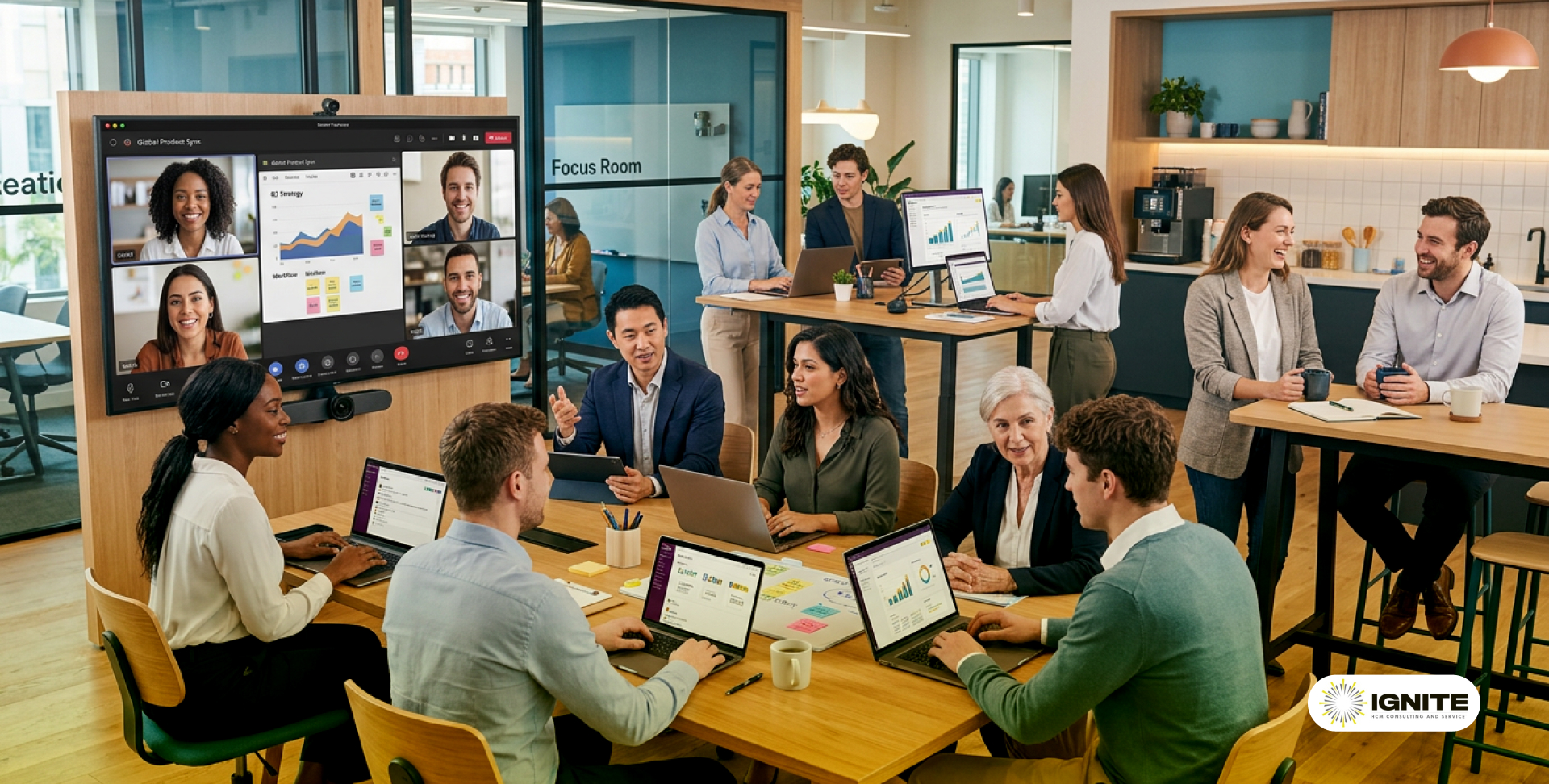
Theory is useful, but let's get specific about what you can implement starting this week.
Not every meeting should be a meeting. This might be the most important shift for hybrid community health. When everything is a video call, people burn out on digital interaction, leaving no energy for genuine connection. Reserve real-time gatherings for what actually requires them:
Start with a genuine check-in question (not "how was your weekend?" but "what's one thing you're proud of this week?") Use breakout rooms to create smaller conversation spaces. Build in "watercooler time" at the beginning—five minutes of unstructured chat before diving into agenda. End with clarity on next steps and appreciation for contributions
If your office space looks the same as it did in 2019, you're missing an opportunity.
When people can do focused individual work from home, the office needs to offer something different. Organizations successfully navigating hybrid have reimagined physical spaces as connection hubs rather than productivity factories.
Google, despite having world-class video conferencing, has invested heavily in designing physical spaces that draw people together—including cafeterias strategically placed to
create "collision" between teams.
In physical communities, sociologists identify "third places"—spaces that aren't home or work where people gather informally. Coffee shops, community centers, parks.
Hybrid organizations need digital equivalents.
The goal is creating spaces where people encounter each other as whole humans, not just job functions.
Not all moments are equal in community formation. Be strategic about when you bring people physically together.
Dropbox, which operates a "Virtual First" model, brings teams together for what they call "Dropbox Studios" sessions—intentional in-person gatherings designed specifically for
collaboration and connection, not routine work.
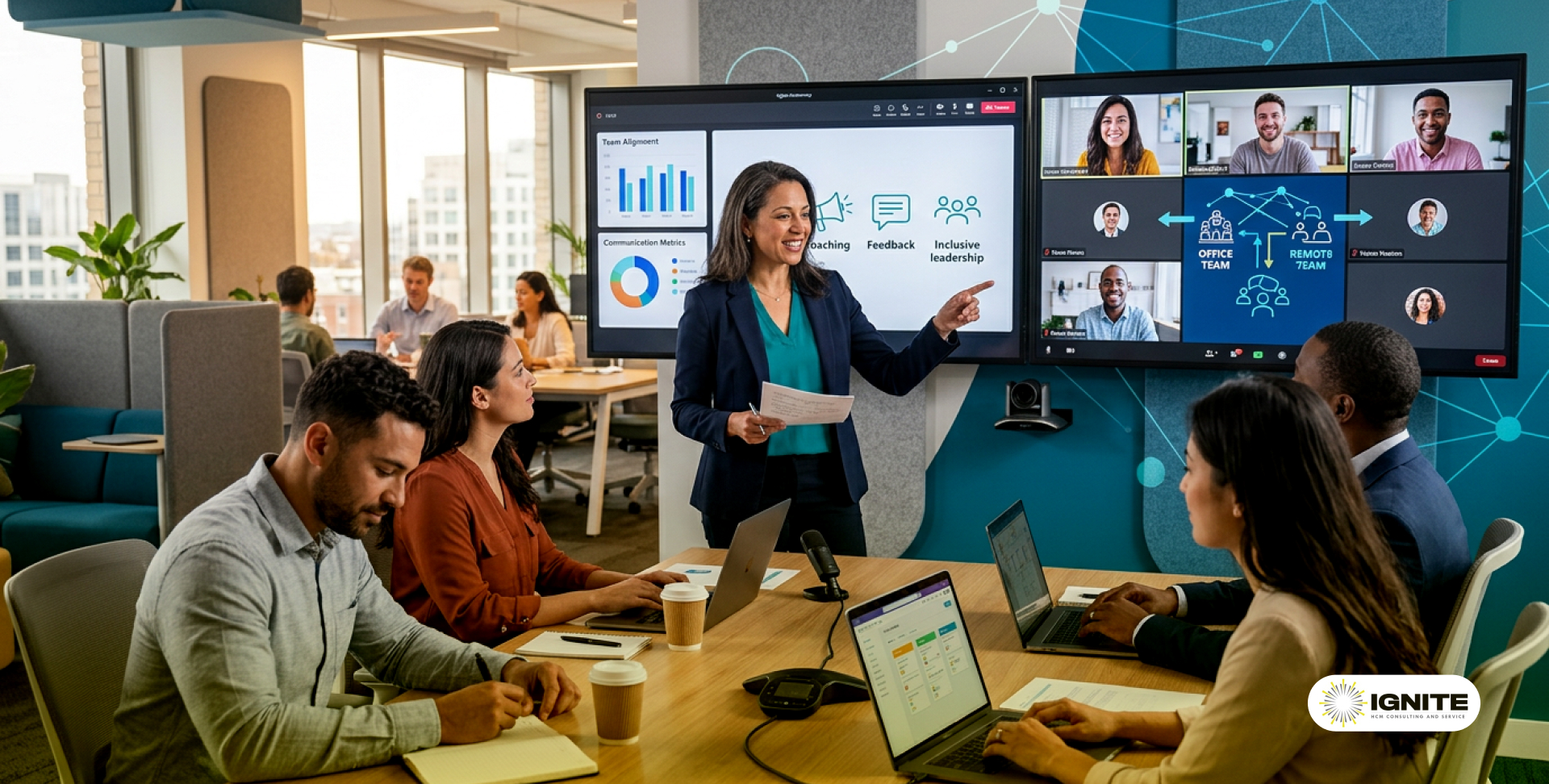
Here's a critical insight: Managers make or break hybrid community.
According to Gallup, 70% of the variance in team engagement is determined by the manager. In hybrid environments, this influence is even more pronounced because managers often become the primary connection point between individual employees and the broader organization.
This isn't intuitive for most people. It requires training, practice, and organizational support.
Community building in hybrid environments has a hidden equity dimension that demands attention.
Research consistently shows that certain groups—including women, caregivers, people with disabilities, and employees from underrepresented backgrounds—often prefer and benefit from remote work flexibility. If hybrid policies inadvertently favor those who come
to the office more frequently, organizations risk undermining years of diversity and inclusion progress.
The standard to hold: No one should be professionally penalized for where they do their work.
You can't improve what you don't measure, but traditional metrics often miss what matters for community health.
These measurements should inform iteration, not judgment. Building hybrid community is an ongoing experiment, not a problem to solve once.
Here's what's easy to miss in tactical discussions about hybrid work: This moment offers an invitation to build something better than what we had before.
Pre-pandemic workplaces weren't community utopias. They included commutes that drained time and energy, offices designed for surveillance rather than connection, and norms that favored extroverts and those without caregiving responsibilities.
Hybrid work, done well, can be more intentional, more inclusive, and more human than what came before.
The organizations that thrive will be those that recognize community as a strategic priority—not a nice-to-have, not HR's problem, but a fundamental driver of performance, innovation, and resilience.
It requires investment. It requires experimentation. It requires leaders who understand that their job isn't just managing tasks but cultivating conditions where people genuinely want to contribute their best.
Community building at scale can feel overwhelming. Start here:
1. Audit your current state. When did your team last genuinely connect—not just communicate?
2. Identify one ritual to strengthen. What existing gathering could become more meaningful with small changes?
3. Ask your people. What do they need to feel connected? The answers might surprise you.
4. Model what you want. Share something personal. Express appreciation publicly. Show up fully.
5. Be patient. Community builds slowly, through consistent small actions, not grand gestures.