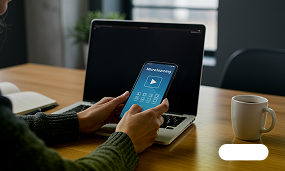
Remember the last time you sat through a two-hour training session at work? If you're like most people, you probably recall approximately... nothing. Maybe a vague concept or two. Perhaps the flavor of the mediocre coffee. But the actual content? Gone, vanished into the cognitive abyss where forgotten information goes to rest.
Here's the thing: it's not your fault. Your brain simply wasn't engineered to absorb massive chunks of information in one sitting. And yet, for decades, we've structured education and professional development around this exact approach—long lectures, dense textbooks, marathon study sessions.
Enter microlearning: the research-backed approach that's completely flipping the script on how we acquire and retain knowledge. Think of it as the wellness equivalent of intuitive eating, but for your brain. Instead of forcing yourself to consume an entire feast of information, you take small, satisfying bites that your mind can actually digest.
---
Microlearning is exactly what it sounds like—learning in micro-sized portions. We're talking about educational content delivered in short, focused bursts, typically ranging from 3 to 7 minutes per session. These bite-sized lessons zero in on one specific concept, skill, or piece of information at a time.
But here's where it gets interesting: microlearning isn't just about chopping up existing content into smaller pieces. It's a fundamentally different philosophy about how humans learn best.
The core principles of microlearning include:
Dr. Hermann Ebbinghaus, a German psychologist who pioneered memory research in the late 1800s, discovered something called the "forgetting curve." His research showed that without reinforcement, we forget approximately 70% of new information within 24 hours. Within a week? That number climbs to nearly 90%.
Microlearning directly combats this cognitive reality by working with your brain's natural tendencies rather than against them.
---
Let's get into the neuroscience for a moment, because understanding why microlearning works makes it even more powerful.
Your working memory—the cognitive system responsible for temporarily holding information available for processing—has a surprisingly small capacity. Psychologist George Miller's famous 1956 research suggested we can hold roughly 7 items (plus or minus 2) in working memory at once. More recent research indicates the number might be even lower, closer to 4 items.
When you're hit with a fire hose of information during a lengthy training session, your working memory essentially throws up its hands and says, "I cannot handle this." Information goes in one ear and out the other because there's simply no room for it to be processed properly.
Microlearning respects this limitation. By presenting small, focused chunks of content, you give your working memory the space it needs to actually work with the information.
Here's a mental model that will change how you think about learning: distributed practice consistently outperforms massed practice.
In plain English? Studying for 30 minutes across six different days will help you remember more than studying for three hours in one sitting. This phenomenon, known as the spacing effect, has been replicated in hundreds of studies across different ages, subjects, and contexts.
Microlearning naturally builds in this spacing. Instead of cramming everything into one session, you engage with material repeatedly over time, allowing your brain to consolidate memories between sessions.
Educational psychologist John Sweller developed cognitive load theory, which essentially states that our brains have a finite amount of processing power for learning. When instructional materials are overly complex or presented in overwhelming quantities, they create excessive cognitive load—and learning suffers.
Three types of cognitive load:
Microlearning minimizes extraneous load by stripping away the unnecessary, keeping lessons lean and focused. This frees up cognitive resources for the germane load—the actual learning.
---
The numbers around microlearning and retention are genuinely impressive.
Research published in the Journal of Applied Psychology found that microlearning makes information transfer 17% more efficient compared to traditional learning approaches. Learners not only acquire knowledge faster but retain it better over time.
A study by Dresden University of Technology discovered that shorter learning modules led to 20% greater retention of information. Participants who learned through brief, focused sessions outperformed those who learned through longer, comprehensive lectures.
The German research institution RWI found that employees who used microlearning were able to learn 50% faster than those using traditional methods. When you're not fighting against your brain's natural limitations, learning becomes dramatically more efficient.
But here's the real kicker: According to research from the Association for Talent Development, microlearning can improve long-term retention by up to 80% when combined with spaced repetition techniques.
Think about that for a moment. The difference between remembering 20% of what you learned versus 80% isn't just incrementally better—it's transformational.
---

Beyond the hard science, there's something almost intuitive about why microlearning feels right. Our brains evolved in an environment where attention was currency. Staying alert to brief, important signals—the snap of a twig, the rustle of grass—could mean the difference between life and death.
We're not wired for sustained attention on a single topic. We're wired for alert, focused bursts followed by mental recovery.
Modern life has only intensified this tendency. Our average attention span has shifted in response to the constant stream of notifications, updates, and stimuli competing for our focus. Microlearning doesn't fight this reality—it embraces it.
The dopamine connection also plays a role. When you complete a microlearning module, you experience a small sense of accomplishment. Your brain releases a hit of dopamine, the neurotransmitter associated with reward and motivation. This creates a positive feedback loop: complete a lesson, feel good, want to complete another lesson.
Contrast this with sitting through a three-hour seminar where your only reward comes at the very end (if at all). No wonder traditional learning often feels like a slog.
---
Understanding the theory is one thing. Actually applying microlearning to your life is another. Here's a practical framework for making bite-sized learning work for you.
This simple approach structures your microlearning sessions for maximum retention:
Fifteen minutes total, and you've done more for your long-term retention than most hour-long study sessions accomplish.
One of the most powerful (and counterintuitive) findings in learning science is this: testing yourself is more effective than re-reading or re-watching material.
Every time you actively retrieve information from memory—rather than passively reviewing it—you strengthen the neural pathways associated with that knowledge. It's like the difference between looking at a map and actually navigating the streets yourself.
Build retrieval practice into your microlearning routine. After each brief session, quiz yourself. Write a summary from memory. Explain the concept to an imaginary audience. The mental effort of retrieval is where the magic happens.
Here's a framework that initially feels wrong but produces superior results: mix up your learning instead of focusing on one topic at a time.
Traditional studying often involves blocking—practicing one skill or topic repeatedly before moving to the next. Interleaving involves mixing different topics or skills within a single study session.
Research consistently shows that interleaving leads to better long-term retention and transfer, even though blocked practice often feels more productive in the moment. When you interleave, your brain has to work harder to retrieve the relevant information and strategies for each problem type—and that extra effort strengthens memory.
---
The beauty of microlearning is its versatility. This approach can be applied to virtually any area where you want to grow.
Instead of annual training marathons, forward-thinking organizations are shifting to ongoing microlearning programs. A 5-minute module on a new software feature. A 3-minute video on customer communication techniques. A quick quiz on compliance updates.
Employees learn more effectively, and organizations see better results from their training investments.
Apps like Duolingo have built empires on microlearning principles. Daily 5-15 minute lessons, gamified for engagement, with built-in spaced repetition. It's not a coincidence that this approach has helped millions of people actually stick with language learning when traditional classes failed them.
Complex health information becomes more accessible when broken into digestible pieces. Understanding your hormones, learning about nutrition, grasping the science of sleep—microlearning makes these topics less overwhelming and more actionable.
Financial literacy can feel intimidating when presented as a comprehensive course. But learning one concept at a time—compound interest today, index funds next week, tax-advantaged accounts next month—builds genuine understanding without the overwhelm.
Want to learn photography, writing, design, or music? Microlearning modules allow you to build skills progressively without burning out. Five minutes on composition today, five minutes on lighting tomorrow, five minutes on editing next week.
---

Perhaps the most valuable aspect of microlearning isn't the science at all—it's the psychological permission it grants.
Many of us have an all-or-nothing mentality about learning. If we can't dedicate two hours to studying, we don't study at all. If we miss a few days of practice, we abandon the pursuit entirely.
Microlearning challenges this perfectionism. Five minutes counts. Three minutes counts. Progress isn't about marathon sessions; it's about consistent small steps.
This connects to a broader philosophy that wellness practitioners have been championing for years: sustainable habits beat intense bursts followed by burnout. Just as a daily 10-minute walk builds health more reliably than sporadic intense gym sessions, daily 5-minute learning sessions build knowledge more effectively than occasional study marathons.
---
Let's be balanced here—microlearning isn't a perfect solution for every learning situation.
Complex, interconnected topics sometimes require longer-form exploration. You can't truly understand certain concepts without seeing how they connect, and breaking them into too-small pieces can obscure those connections.
Deep skill development often requires extended practice sessions. A surgeon can't learn an operation in 5-minute increments. A musician needs long practice sessions to build stamina and flow.
Oversimplification is a real risk. When content is condensed too aggressively, nuance can be lost. The goal should be focused simplicity, not dumbed-down shallowness.
The wise approach is to use microlearning as one tool in your learning toolkit—the right tool for many situations, but not the only tool you'll ever need.
---
Ready to experience the power of bite-sized learning for yourself? Here's a simple seven-day experiment.
Day 1: Choose one topic you want to learn more about. Find a video or article that takes 5 minutes or less to consume.
Day 2: Without looking at yesterday's material, write down everything you remember. Then review to fill in gaps.
Day 3: Learn one new micro-concept in the same topic area. Connect it to what you learned on Day 1.
Day 4: Teach what you've learned to someone else (or explain it to yourself out loud). Notice what you can't articulate clearly.
Day 5: Take a brief quiz or test yourself on the material from Days 1-3.
Day 6: Learn one more micro-concept. Notice how the pieces are starting to connect.
Day 7: Review all material and reflect on how much you've learned in just seven sessions of 5-10 minutes each.
Most people who complete this simple experiment are genuinely surprised by how much they retain compared to their usual learning approaches.
---
Your brain is remarkable, but it has limits. For too long, we've designed education and training as if those limits didn't exist—as if humans could simply absorb unlimited information through sheer willpower.
Microlearning represents a more humane approach to knowledge acquisition. By working with your brain's natural tendencies rather than against them, you can learn faster, remember more, and actually enjoy the process.
The research is clear: smaller bites lead to better retention. The forgetting curve can be flattened. Cognitive load can be managed. And the spacing effect is real.
The information you learn is only valuable if you actually remember it. Microlearning gives you dramatically better odds of converting time spent learning into lasting knowledge.
So the next time you're tempted to power through a marathon learning session, remember: your brain is asking for snacks, not a feast. Honor that request, and watch your retention transform.
---
The takeaway? Start small. Stay consistent. Trust the science. Your future self—the one who actually remembers what you learned—will thank you.